




Category: Super Healthy

I Do Not Love Kale

May 9, 2013

I’m thinking of starting a support group for People Who Do Not Love Kale. Would you join me? Are you, like me, sick of hearing/reading about kale?  I’d actually like someone to explain the kale phenomenon to me.  Why is it that this vegetable specifically has been singled out as the second coming? Why the special treatment? And really – kale? It’s not the sexiest of vegetables. Someone I know said they would like to hire the PR firm that is responsible for the kale explosion.

Not only do I not get the hype, I have to say I don’t really get kale.  I use it. I like it better than some of its other dark leafy siblings (although I love this chard dish and chard is also lovely in this tart, and collard greens are terrific in this curry). I have made kale chips and my kids spit them out and honestly, so did I.  Often I have a choking sensation when I eat kale. Does anyone else have this reaction? I’ve learned to chop it in small bite size pieces no matter what dish I am throwing it into. I don’t have to do this with broccoli. Broccoli never makes me choke. (I love you broccoli!)

I keep trying to love it. I keep trying to get excited about it. I keep buying it at the farmers’ market because it is always there and I must need some of that, right? I put it in soups and stews and sometimes I just let it languish in my crisper drawer.   Which is saying something because kale keeps well.  Then I feel guilty and so I sauté it in olive oil with minced garlic and red pepper flakes, let it cool, and then keep it in the refrigerator to eat with quinoa, avocado, and poached eggs. (My new husband-is-out-of-town dinner.)

Just as there is a lot of hype about kale, there is a lot of hype about Deborah Madison these days. (Nice segue, don’t you think?) The difference is, in my opinion, Deborah Madison deserves every bit of it and then some. Her new book Vegetable Literacy is a beautiful and well-researched tome that every vegetable lover should own. Especially if you garden (which I don’t). The thing I find so incredibly inspiring about Ms. Madison is that after all these years and all these books, she still has the passion for food that she has always had, and the curiosity to do investigative journalism about produce. The book, as you have no doubt heard, is arranged by vegetable “families” and I had plenty of surprises seeing which vegetables and herbs are related.

The recipes are true Deborah Madison. If you own a few of her books (or six like I do), you might see some familiar things. Sometimes things are a little more complicated than they need to be, sometimes they are shockingly simple. In just a quick casual glance through the book, I saw no fewer than 15 things I wanted to try right away. I’ve already made one thing twice (a simple dip of all things), and I know that her recipes are tested to perfection and fairly portioned. You never have to wonder as you attempt one of her recipes whether it will turn out. And if it doesn’t, it is most certainly your fault, not hers.

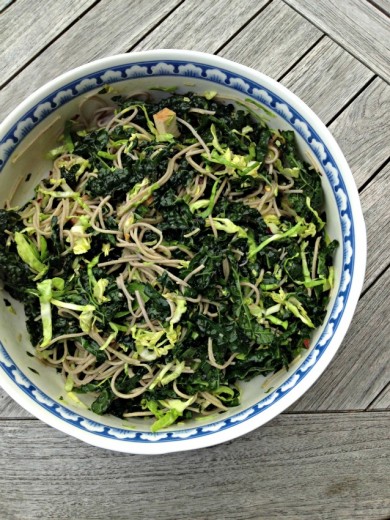
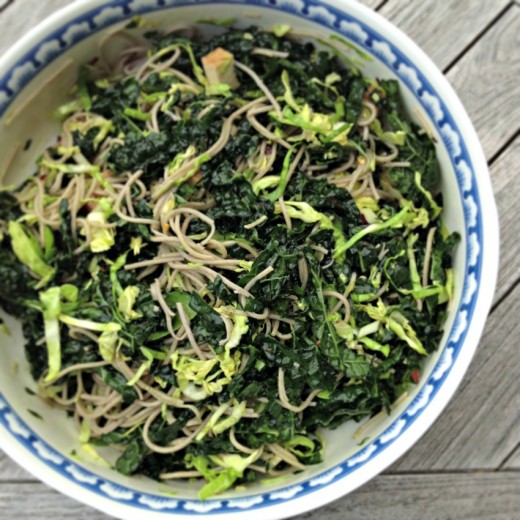
This dish spoke to me at a time when I was not eating many things. For three weeks, I ate fruits and vegetables, nuts and seeds, and lots of eggs. I was trying to see if my acid reflux had to do with a food intolerance.  You can used to a diet like that but it isn’t much fun. I decided that if I used 100% buckwheat soba noodles (which are gluten free) then this dish fit into my elimination diet. It is a testament to how tasty it is (even with the kale) that I would make it again, even now that I am eating normally again.


Buckwheat Noodles with Kale and Sesame Salad
Adapted from Vegetable Literacy
Serves 2 as a main course or 4 as a first course

While I will say that you should never rinse traditional Italian-style noodles, you should definitely rinse soba noodles.  They are very starchy and will clump together in one big lump if you don’t.  This recipe calls for both toasted and light sesame oils.  Toasted sesame oil is a tremendous flavor booster but you have to be careful with it as the flavor is very strong.  If you don’t have light sesame oil (I don’t), you can use peanut oil or even canola oil for that part of the recipe.

6 ounces soba noodles (make sure they are 100% buckwheat if you want gluten free)
Toasted sesame oil
1 bunch Tuscan kale (also called lacinato or dinosaur kale)
5 tsp. light sesame oil (not toasted)
Sea salt
4 brussels sprouts
1 plump garlic clove
1 tbsp. rice wine vinegar
1 tsp. soy sauce
1 tbsp. sesame seeds, toasted in a dry skillet until golden
2 pinches red pepper flakes
Slivered chives or green onions to finish

Cook the soba noodles in a large pot of boiling salted water.  Check the package for how they need to cook and taste a noodle to make sure they are not overdone.  Drain and immediately rinse with cold water, running your hands through the noodles to make sure they are cool.  Give them a good shake and then drizzle them with a bit of toasted sesame oil, mixing them with your hands.

Slice the kale leaves off their ropy stems and discard the stems.  Working in batches, stack the leaves, roll them up tightly lengthwise, and then thinly slice them crosswise into narrow ribbons.  Put the ribbons in a salad bowl with 1 teaspoon of the light sesame oil and a pinch of salt.  Squeeze the leaves repeatedly with your hands until they glisten.

Discard any funky outer leaves from the brussels sprouts.  Slice them paper thin on a mandoline (or with a very sharp knife), then toss them with the kale.

Pound the garlic with another small pinch of salt in a small mortar until smooth.  Stir in the vinegar then whisk in the remaining oil and the soy sauce.  Pour the dressing over the greens and toss well.  (If you don’t have a mortar and pestle, you can also chop it roughly on a cutting board, sprinkle the garlic with the salt, and then use the flat side of your knife to smoosh the salt into the garlic.  You are looking for a rough paste consistency.  Then just transfer the garlic to a bowl and continue.)

Just before serving, toss the greens with the soba noodles, the sesame seeds, pepper flakes, and the chives.


Indian Food Pep Talk

May 6, 2013

Let’s talk about Indian food.  Do you love it?  Are you making it at home?  If the answer to the first question is yes and the second is no, why not?  Why are you not making Indian food at home?  I’m guessing it is one of these reasons:

1) The recipes are too long.
2) The recipes have unfamiliar ingredients.
3) It’s too spicy!
4) Who has all those spices?

You might notice that reasons 1-4 actually have to do with spices.  #1 Sometimes Indian food recipes have long lists of ingredients but if you look carefully, many of those ingredients are actually spices.  Sometimes up to half of the list really just needs to be measured out of a jar.  #2 Once in a while, I will find a recipe that calls for bitter gourd or drumstick (not the kind that is on a chicken) but usually the unfamiliar ingredients are actually spices.  #3 “Spicy” and “spiced” are really too different things.  Yes, there are a lot of spices in Indian cooking and that is why it is so intoxicating.  Most of the spices are there to give the food flavor and color, not necessarily heat.  When you are cooking it yourself, you control the level of heat so what are you afraid of?  #4 needs a new paragraph.

If you cook regularly, you probably have jars of cumin, coriander, and cayenne at home, these are spices commonly used in Indian food but also in Thai, Mexican, and Middle Eastern food, among others.  Perhaps you even have turmeric and mustard seeds.  Maybe you don’t.  Maybe you want to make a recipe that calls for fenugreek and garam masala and when you see that you think to yourself, “Now this is why I don’t make Indian food.”  I’m here to tell you that you don’t have to go buy whole jars of things that you are not going to use on a daily basis.  Most grocery stores these days have a bulk spice section where you can buy a couple of teaspoons for less than a dollar.  An added bonus is that the bulk spices tend to be much fresher than those you get in a  jar because there is a lot of turnover.  Take a tip from me and clearly write on the bag which spice it is and then store all your little bits of spices in one Ziploc bag.  That way, you can pull out that one bag when you want to make Indian food.  If you are looking for online resources for spices, I can highly recommend World Spice Merchant and Penzey’s.  World Spice Merchant has a storefront in Seattle and Penzey’s has locations all over the U. S.

Now that we are not afraid anymore, can we continue?  I make Indian food often in my kitchen.  I was never a fan of the Indian restaurants in Seattle so when I craved it, I made it myself.  I turn to several trusted cookbooks over and over and although I am a person always wanting to try new recipes, I gravitate toward the same dishes.  They are that good.

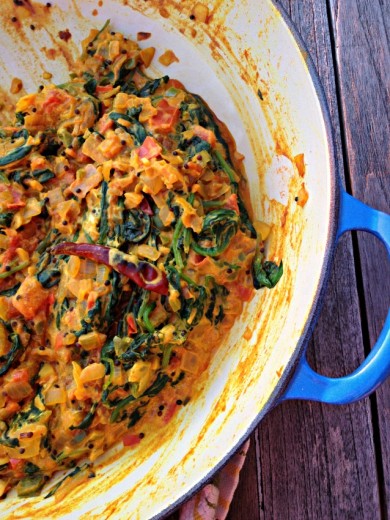
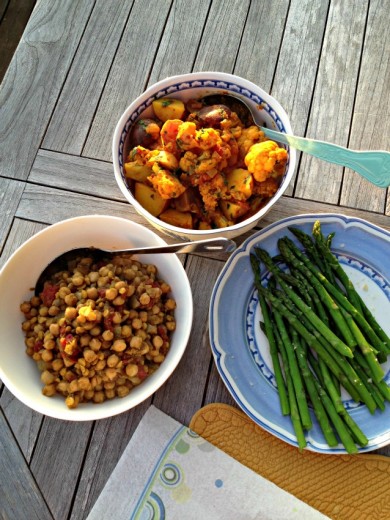
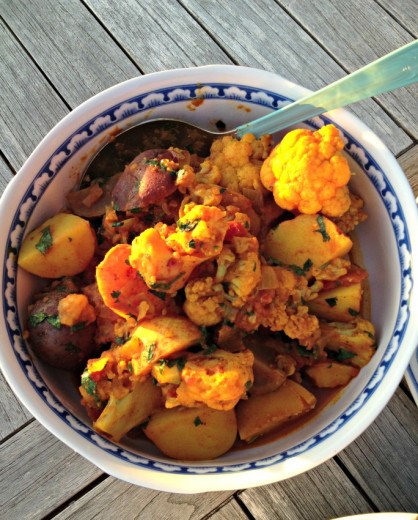
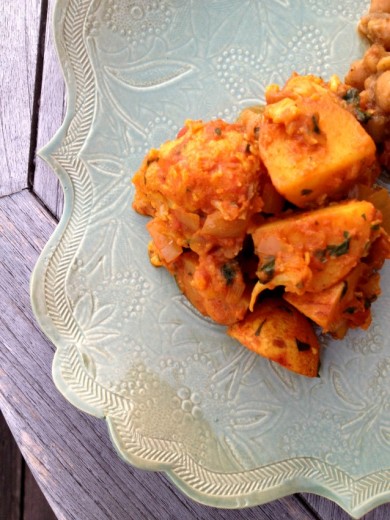
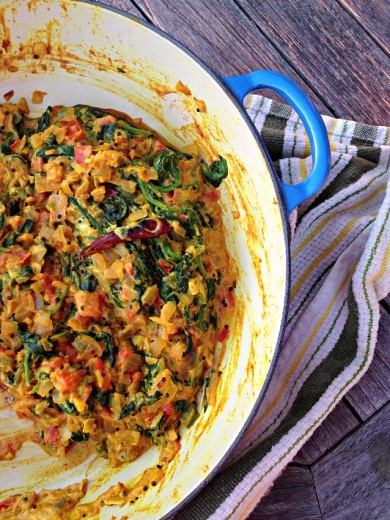
This Cauliflower and Potato Curry is a great place to start if you are apprehensive about cooking Indian food.  The recipe is easy, the ingredient list relatively short, ingredients are familiar, and it is not spicy (as in hot).  I have probably made this recipe 30 times and I change up little things each time.  Sometimes I use big tomatoes that I seed, sometimes I use cherry tomatoes, sometimes I use canned tomatoes.  I have made it with more cauliflower and fewer potatoes, and also with more potatoes and less cauliflower.  I’ve added frozen peas on more than one occasion.  I’ve used all coconut milk and also half coconut milk and half water.  I have made it soupier and drier.  My point is this is a very adaptable recipe.  How you see it below is how I like it best.

One Year Ago:  Flan, Layered Pasilla Tortilla Casserole
Two Years Ago:  Cheddar Crackers (I’ve made these about 1,000 times), Kaye Korma Curry
Three Years Ago:  Gianduja Gelato, Orange Grand Marnier Cake, Spaghetti with Mushrooms, Asparagus, and Tarragon
Four Years Ago:  Mexican Brownies, Noodles in Thai Curry Sauce with Tofu,

Cauliflower and Potato Curry
Adapted from The New Tastes of India
Serves 4

Coconut oil (or canola or peanut oil)
1 ½ tsp. fennel seeds
1 large onion, finely chopped
1 tsp. turmeric powder
1 tsp. chile powder
1 6-ounce can tomato paste
1 ¼ pound new potatoes (assorted colors are nice), cut into large chunks
1 small cauliflower, about 1 ¼ pounds, broken into florets
4 plum tomatoes, quartered and seeded
4 ounces coconut milk
4 ounces water
Kosher or sea salt
Handful of chopped cilantro

Heat a Dutch oven over medium heat.  Add just enough oil to coat the bottom of the pan.  Sprinkle in the fennel seeds and allow them to cook, stirring often, until they are toasted and fragrant, about 3 minutes.  Add the onion and cook until the onion is turning brown, about 10 minutes.  Add the turmeric and chile powder and stir for 2 minutes.  Stir in the tomato paste.

Add the potato, cauliflower, tomatoes, coconut milk, and another healthy pinch of salt.  Next stir in the water.  Bring the mixture up to a boil, then lower the heat to a simmer and cover the pot.  Allow to cook at a brisk simmer until the potatoes and cauliflower are tender, about 20 minutes.  Be sure to check with a fork or a paring knife.  If the mixture needs more liquid in your opinion, add more water or coconut milk.  Just before serving, taste for salt, and stir in the cilantro.


My Old Job

April 25, 2013

My first job working with food kind of fell in my lap.  I had a good friend who had recently hired a personal chef.  While she liked the convenience, she found the food heavy and not all that inspired.  Without thinking too carefully I said, “I’ll cook for you.”  Without thinking too carefully she said, “OK.”  And suddenly, poof!, I was a personal chef.  The arrangement worked out for both of us and my friend recommended me to another family.  Up until I had Spencer, I cooked for those two families three nights a week.

When all was said and done, I did that job for three years.  I had my two regular families for all that time and a few others who stopped and started.  Graham, who is now eight, was 17 months old when I started cooking for money and I did it through my pregnancy with Spencer and, after a short maternity leave, when he was an infant.  I was lucky to have had very flexible clients who were great eaters and were just happy to eat whatever I brought them.  I was able to be creative and make a serious dent in my “want to make” recipe file.

I kept notebooks with every menu I ever made.  It is amazing to look back and see the food I was able to produce in my kitchen with very small children and not a lot of time.  In all three years, I almost never repeated dishes and when I did, it was because someone had made a request.  I’ve been thinking about those days recently because I’ve been thinking about whether or not I’d like to start personal cheffing again.  I loved doing it and the only reason I stopped is because I found the work too solitary.  Teaching cooking classes allowed me to have prep time alone but then to share time and food with others.

Whenever I think about starting up again, I think of this dinner.  It was the first thing I made for my first client and I agonized over the choice.  I felt so much pressure (from myself) for the meal to be a hit.  I wanted so badly to succeed.  Because of that, I went to a no-fail cookbook, Vegetarian Suppers from Deborah Madison’s Kitchen, and made a favorite dish.

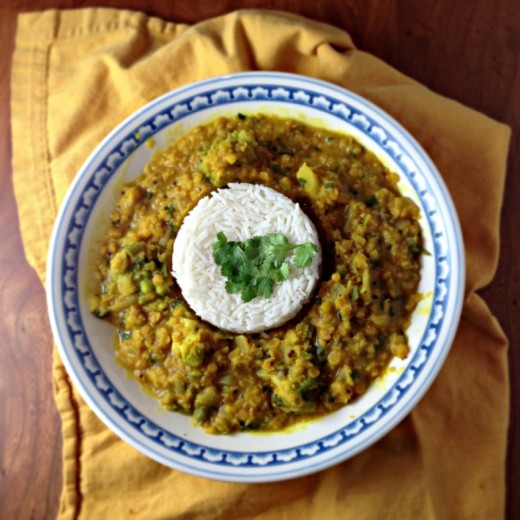
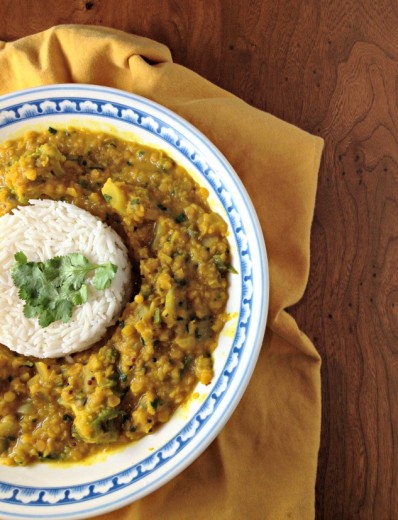
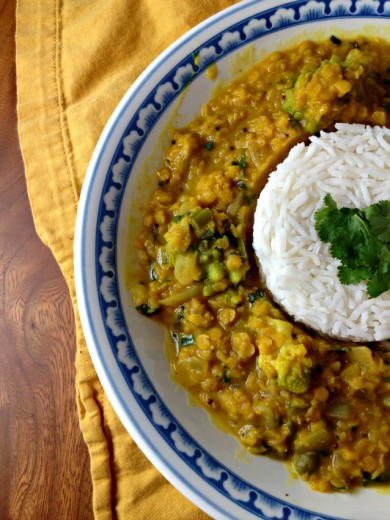
Over the years since I hung up the personal chef hat, I have made this dish many times.  I’ve made others like it too – I just really like my red lentils.  They are quick cooking and healthy and in about the time it takes for the rice to cook, you have a tasty and nutritious meal.  Recently I saw tables full of broccoli romanesco at the farmers’ market and whenever I see that beautiful vegetable, I always think of this dish.  After several years of making other versions of red lentil dhal, it was nice to come back to an old favorite.  There are a lot of steps to her recipe, and a little underseasoning, so I tweaked it to my current tastes.  Still, a classic is a classic.

One Year Ago:  Ginger Fried Rice with Roasted Tempeh, Maple Blueberry Tea Cake
Two Years Ago:  Butterscotch Pudding Tarts, Greek Salad
Three Years Ago:  Leek Frittata, Strawberry Ricotta Tartlets
Four Years Ago:  Ricotta Calzones with Broccoli Rabe, Miso Soup
[/donotprint]
Fragrant Red Lentils  with Broccoli Romanesco
Adapted from Vegetarian Suppers from Deborah Madison’s Kitchen
Serves 4

The final swirl of spices in oil might sound like an annoying extra step but it is really what makes this dish special.  I like to use coconut oil in this type of cooking but feel free to use butter, ghee, or another type of oil.

3 tbsp. coconut oil
1 small onion, finely chopped
1-inch piece fresh ginger, peeled and minced
3 cloves garlic, minced
1 large jalapeño chile, seeded and diced
2 tsp. ground cumin
1 tsp. ground coriander
1½ tsp. ground turmeric
¼ tsp. cayenne
2 cups red lentils
1 bay leaf
Kosher or sea salt
1 can coconut milk
1/3 cup finely chopped cilantro, plus extra for garnish
1 head broccoli romanesco or cauliflower, cut into bite sized pieces
1 tsp. mustard seeds
1 tsp. cumin seeds
Cooked basmati rice for serving

Place a large saucepan over medium heat.  Spoon in about 1 tablespoon of the coconut oil, then add the onion and a large pinch of salt.  When the onion is translucent and starting to brown, about 5 minutes, add the ginger, garlic and chile.  Sauté for a couple of minutes, then add the ground cumin, coriander, turmeric, and cayenne.  Stir for one minute, then add the lentils.  Stir to coat the lentils with the spices, then pour in 3 cups of water.  Turn up the heat so the mixture boils, then add the bay leaf, and turn the heat down so the mixture simmers.  Partially cover the pot and cook until the lentils are soft and most of the water is absorbed, about 15 minutes.

Add the coconut milk and simmer for another few minutes until the lentils are very soft and falling apart.  Remove from the heat and stir in the cilantro.  Cover and keep warm.

Steam the broccoli romanesco or cauliflower until tender.

To finish, heat another tablespoon of coconut oil in a small skillet over medium-high heat.  Add the mustard and cumin seeds and cook until they become very fragrant and the mustard seeds start to pop.  Immediately add to the red lentils and stir to combine.

To serve, pack the hot rice into ramekins and turn them upside down, one each, in a shallow pasta bowl.  Spoon a cup or more of the lentils around them, then lift off the ramekin, leaving the rice intact.  Top with the broccoli romanesco and garnish with cilantro sprigs.


Crushing on Salad

January 24, 2013

I have always liked boys.  When I was in first grade, I was head of the “kisser girls”, the club whose duty it was to run after boys on the playground, catch them, and kiss them.  With all the boys to choose from, some of whom slowed down noticeably so we could catch them, it was hard to settle on one for a “boyfriend”.  Once I started second grade, I fell for a sweet boy who was taller than me and lived in a blue house with an eagle over the door.  He was my crush in third grade too and again in sixth grade after I spent fourth and fifth pining over a boy who wouldn’t give me the time of day.  I had my first serious boyfriend in seventh grade and from there things got a little more complicated. But throughout my single life, I always had crushes.  Some of them turned into relationships, others didn’t.

These days, I am happily married and crushes on guys are a thing of the past. So now I crush on salads. Sometimes the crushes turn into full blown love affairs as in the case of this salad (my spring stand-by) and this one (my fall stand-by).

Meet my new crush. Or, seeing as I have made it countless times in the past month, my new love. There are so many things to fall for here. Even though the dressing has vaguely Asian flavors, it goes with any meal you want to serve from soba noodles to linguine. I should know because I’ve served it with just about everything. It is the rare salad that can actually be dressed ahead of time and does not get wilty. The core ingredients are things that keep well in your refrigerator so you could theoretically make it at a moment’s notice. The dressing keeps well too. You can scale it up easily to feed a crowd, it is crunchy and light but satisfying with lots of umami (thank you miso paste) and all in all, it would make a great boyfriend if it was, you know, a person.

As written, this is a terrific recipe. I’ve changed a few things in the way I make it to reflect personal taste. (I’ll give you the recipe the way Deb wrote it.) I prefer to make it with raw snap peas rather than blanched. It saves a step and I like the crunch and intense sweetness of those pods when they are raw. Blanching gives them a bit of a funky flavor in my opinion. Also, I cut back on the amount of scallions because I don’t enjoy the taste of raw onion, especially in salad. For the dressing, I do use the sesame oil but not the vegetable oil. Instead, I use water for the liquid, 2 – 4 tablespoons depending on how it is coming together. I’ve made the dressing in both my mini food processor and my blender and it came out great both ways. I would recommend doubling it.

One Year Ago:  Celery Root Soup, Apple Cheddar Quick Bread
Two Years Ago:  Roasted Tomato Salad with Croutons, Meyer Lemon Risotto Cakes
Three Years Ago:  Peanut Butter Cookies with Milk Chocolate Chunks, Chickpea , Chard, and Couscous Soup, Soba Noodles with Crispy Tofu
Four Years Ago:  Sliced Eggplant Spread with Crostini, Lemon Bars

Snap Pea Salad with Miso Dressing
The Smitten Kitchen Cookbook
Serves 4-6

I made this dressing with peanut butter when I was out of tahini and it tasted great.  Please don’t skip the step of toasting the sesame seeds.  Like most nuts and seeds, their flavor really comes out when they are given some heat.  Just keep a close eye on them so they don’t burn.

Table salt for the pot
½ pound sugar snap peas, untrimmed
½ pound Napa cabbage, in thin ribbons (about 3 cups)
4 ounces radishes (4 medium-large) julienned, or quartered and thinly sliced
3 large scallions (about ½ bundle), white and green parts only, thinly sliced on bias
3 tbsp. sesame seeds, well toasted (300-degree oven for 5 to 8 minutes)

Sesame-Miso Dressing
1 tbsp. minced fresh ginger
1 large garlic clove, minced
2 tbsp. mild yellow or white miso, plus up to 1 tbsp. more
2 tbsp. sesame seed paste or tahini
1 tbsp. honey
¼ cup rice vinegar
2 tbsp. toasted sesame oil
2 tbsp. vegetable or olive oil

Blanch sugar snap peas:
Bring a large pot of salted water to a boil, and prepare a small ice-water bath.  Boil the sugar snaps for about 2 minutes, or until just barely cooked but still crisp.  Scoop them out with a large slotted spoon, and drop them in the ice-water bath.  Once they’re cool, drain and pat dry.  Tim ends and cut sugar snaps on bias into thin slices.  Toss in large bowl with cabbage radishes, scallions, and 1 tablespoon sesame seeds.

Make the dressing:
Whirl all ingredients, using the smaller amount of miso, in a blender until smooth.  Taste and adjust the ingredients – use the extra tablespoon of miso if desired.  Don’t fret if it is a tad salty, and try to resist the urge to compensate with extra honey.  The sugar snaps have a mellow sweetness to them that balances well with a saltier-than-normal dressign.

Assemble the salad:
Toss salad with half of dressing, and taste.  Use more if you desire.  Sprinkle with remaining sesame seeds.


Rethinking January

January 17, 2013

As an almost lifelong resident of Seattle, January was always my least favorite month.  I always felt a huge let down after the holidays and facing 31 days of rain and cold always put me in a bad mood.  The fact that the sun set around 4pm didn’t help and it certainly didn’t help that we couldn’t actually see the sun when it did set.  I always have had the perspective that it was so much worse in other parts of the country, places where you could actually freeze if you went outside, or you couldn’t go outside at all.  But usually those frosty places had this thing called spring that you could look forward to.  Thawing, sunshine, warmer temperatures.  Seattle often didn’t have that thing called spring.  Winter would just go on and on and it would get light later but it would still be cold and rainy.  Finally in July, or maybe August, summer would start.  So you can see why January could be particularly cruel.  With no guarantee of spring, 31 days can feel a lot longer.

Things have changed.  We live in Oakland now.  I don’t think it has rained once in January.  I wake up everyday to sunshine.  I’m not quite sure what to do with that.  I find myself worrying that something is wrong, why is the sun shining again??  It has been cool, crisp, and beautiful.  We are going to creep up into the mid-60′s this weekend and that, my friends, is practically like summer to this Seattle girl.  I haven’t been wearing my multiple pairs of boots and I’ve only worn my down jacket, the one I lived in from October to May last year, a handful of times.  It’s weird.  And wonderful.

Why all this talk about the weather?  Well, food is so connected to how you feel.  I’ve always listened to what I crave, beyond french fries and brownies, and tried to cook according to what sounds good.  Salads and light pastas are what I want in summer, green! green! green! in spring, roasted root vegetables and hearty soups sound best in winter.  What do you do when you no longer feel the need to roast everything?  When you don’t turn on your oven to bake but also to warm up your kitchen?  When soup sounds good but isn’t a full-on I-need-something-warm-in-my-belly-this-instant?

Well, you still make soup.  As a card-carrying member of the Soup Lovers Society, soup always sounds good to me.  I even like it in summer, either a cold one or a hot one served barely warm.  This lovely addition to my repertoire is the type that can be served year round.  It is hearty enough to serve as a main course with a delicious salad, and pretty enough to serve in small bowls as the start to an elegant dinner.  I love the smooth texture of perfectly blended soup but if it is going to be dinner, I need to chew.  Here we have a silky smooth spiced cauliflower base with bits of millet and bright green peas to keep it texturally interesting.  It has a wonderful creamy mouth feel without any cream.

Finally, I have become completely obsessed with these super spicy chiles that my friend Allison introduced me to.  Sicilian Pepperoncinis.  Eating dinner at her house, we sprinkled them over a delicious homemade lasagne and as we did so, she warned us, “Those are super spicy!”  Randy and I nodded our heads because we like super spicy and then WHOA! those are super spicy!  I had to have some!  So Allison, Denise, and I make a pilgrimage to Boulette’s Larder in the Ferry Building in the big city and ate really expensive soup (not as good as the one this post is about) and bought chiles.  Which I am grinding in a mortar and pestle and sprinkling on everything.  I think this soup tastes amazing with some spice but you can easily leave it off.

One Year Ago:  Pizza with Leeks, Smoked Mozzarella, and Eggs, Gingerbread-White Chocolate Blondies
Two Years Ago:  Gingerbread with Maple Cream Cheese Frosting, Baked Tofu with Peppers and Olives
Three Years Ago:  Oatmeal Carmelitas, Chunky Vegetable Pot Pie
Four Years Ago:  Milk Chocolate Frosted Layer Cake

Curried Cauliflower Soup
Adapted from Food and Wine
Serves 4

I have puréed this soup in a blender and also with an immersion blender.  The blender will give you that silky smooth texture but the millet breaks that up, so save on mess and use an immersion blender if you have one.  You might find that you don’t want to add all the millet to the soup pot. 

½ cup millet
1 cup water
Kosher or sea salt
Olive oil
1 medium onion, chopped
3 garlic cloves, minced
1 tsp. ground cumin
1 tsp. ground coriander
1 tsp. turmeric
½ tsp. cayenne pepper
One 2-pound head of cauliflower, cut into florets
6 cups vegetable stock
2 cups peas, fresh or frozen
Crushed red pepper flakes, for sprinkling (optional)

In a medium saucepan, combine the millet with the water and a pinch of salt.   Bring to a boil.  Cover and simmer over moderately low heat until the millet is tender, about 20 minutes.  Set aside.

Place a large saucepan, or a Dutch oven, over medium heat.  Drizzle in just enough olive oil to coat the bottom of the pan and add the onions with a large pinch of salt.  Cook over moderate heat until softened and browning in places,  stirring occasionally, about 10 minutes.  Add the garlic, cumin, coriander, tumeric, cayenne, and another pinch of salt and cook, stirring, until fragrant, about 2 minutes.  Add the cauliflower and the stock.  Bring to a boil.  Cover, reduce the heat to moderately low, and simmer the soup until the cauliflower is very tender, about 15 minutes.

Working in batches, carefully purée the soup in a food processor or a blender.  (Or use an immersion blender directly in the pot.)  Return the soup to the pot and add the cooked millet and the peas.  Rewarm gently over moderate heat.  Season with salt, if needed.  Sprinkle with red pepper flakes (if using) and serve.

(This soup, like most, is great the next day.  It gets pretty thick with the millet absorbing the liquid but I didn’t not mind that at all.  If you want a soupier consistency, just add some water or broth when you reheat it.)


« Older Posts