




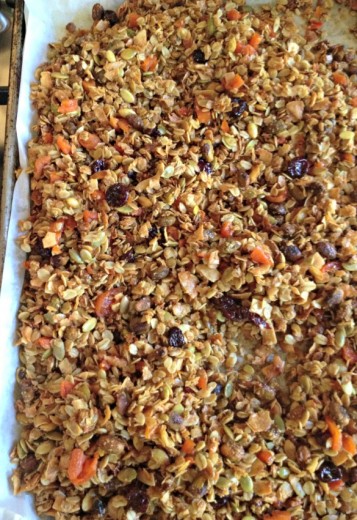
This is my go-to granola recipe. I have been using it for about three years. I had a go-to granola recipe before that that I used for many many years, but I like this one better. I make huge batches of it and eat some, freeze some, and give some away. Everyone loves it. Why have I not shared this recipe until now? Here are some reasons.
1) A part of me thinks that everyone has their own favorite granola recipe.
2) A part of me thinks I have seen 12 million granola recipes in the food blogosphere.
3) A part of me doesn’t want to take business away from this lovely lady. (And if you are buying granola instead of making your own, you should buy it from her.)
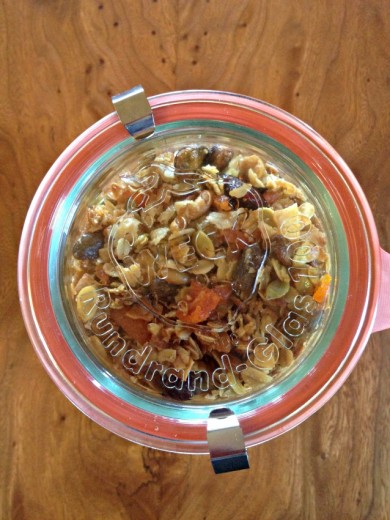
My old favorite starred a lot of butter and honey and had lots of whole nuts in it. I liked the flavor of it, butter and honey will do that to a person, but not the things in it as much. If I am going to eat granola, and let’s face it – it’s not exactly health food – it has to be perfect. This is pretty close and oh so easy to make. You are really just measuring things out, mixing them all together in a big bowl, and waiting. Your kitchen smells even better than when you make brownies. Why am I sharing the recipe now? Here are some reasons.
1) It’s just time I shared something that I make so often, regardless of reasons 1-3 above.
2) I brought giant bags of this granola with us to Bethany Beach a few weeks ago. We kept one bag in the purple house and I brought the other over to the blue house, where much of the extended family was staying. They all went crazy for it (people always do) and wondered when the recipe would be on my blog. These are special lovely people. So how could I not share?
A brief story. I met Randy’s family, immediate and extended, twelve years ago this month. We had just moved in together and he brought me back to a big family gathering in Baltimore. Randy’s mom is the oldest of five and three of her siblings have children. Some of them have children. Even twelve years ago, there were a lot of White’s for me to meet. I was nervous. I knew Randy and I were headed for marriage and he had been married before (as had I). His ex-wife had been a part of these gatherings and I did not know how I would fit in to that dynamic.
As it turns out, Randy’s ex-wife was not super popular with the family, some of the more tell-it-like-it-is members were very clear about this, and I was thought to be a breath of fresh air. The fact that I come from a nice family, sing and play the guitar, and was clearly over the moon about this guy brought me a big thumbs up from everyone. Phew! Now all the times I have spent time with this group has been so wonderful. I always have long and meaningful conversations with so many of them. I’m lucky to have this large extended family. So it is with great pleasure that I share this granola recipe!
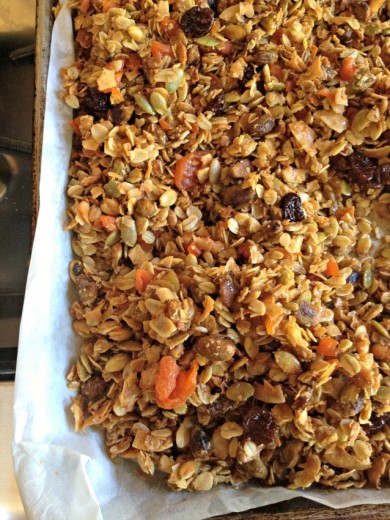
A few notes. This recipe comes from Melissa Clark’s book In the Kitchen with a Good Appetite. As may be clear, I have made it countless times. I pretty much follow it as written but have a few opinions (always!).
*It is very easy to double this recipe as long as you have a large mixing bowl and two large rimmed baking sheets. Why not just double it and have lots of granola? I would freeze some since it does, eventually, go stale.
*You can use salted, roasted pistachios instead of raw, I always do. I buy them in huge shelled bags because I make this so often.
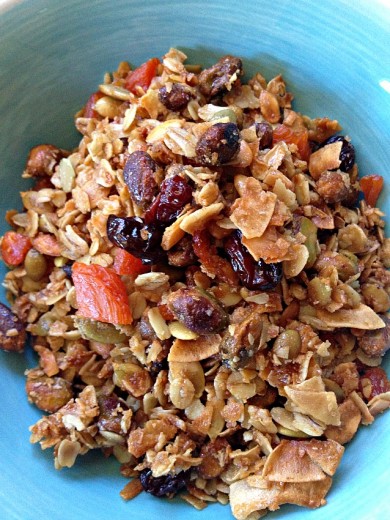
*You will need to seek out coconut chips. It is just big shavings of coconut, not the powdery flaky kind that you use to make coconut bars. Bob’s Red Mill has it in bags usually in the baking section.
*I add both dried apricots and dried cherries to mine. Better color. I’ve added all kinds of dried fruit to this granola. The only thing I would avoid are regular raisins. They don’t look appetizing. Golden are better. Be sure to add the fruit right when it comes out of the oven. The granola is still soft and easily mixable. As it cools, it crunches up and the fruit is more difficult to stir in.
*Be sure to allow the granola to bake long enough that it really is golden, a touch darker is better than a touch lighter in my opinion. If you let it become truly brown, it cools up nice and crunchy. If you don’t bake it enough, it can be a little greasy and not crunchy.
One Year Ago: Quinoa with Red Lentils and Mint, Baked Penne with Silky Fennel
Two Years Ago: Savory Muffins, Salted Caramel Squares, Vegetable Enchiladas
Three Years Ago: Roasted Cauliflower with Tomato and Dill, Best Tart Dough, Lavender Honey Ice Cream
Four Years Ago: Honeyed Goat Cheese Tart, Blasted Broccoli, Gnocchi with Mushroom Sauce, Asparagus Ragout
Olive Oil Granola with Dried Apricots and Pistachios
Adapted from In the Kitchen with a Good Appetite
Makes about 9 cups
Clark serves her granola with ricotta cheese and fresh berries. I usually put out milk and plain yogurt with berries.
3 cups old-fashioned rolled oats
1½ cups raw pistachios, hulled
1 cup raw pumpkin seeds, hulled
1 cup coconut chips
¾ cup pure maple syrup (you can use 2/3 cup, but the granola will be drier_
½ cup extra-virgin olive oil
1/3 cup packed light brown sugar
1 tsp. kosher salt
½ tsp. ground cinnamon
½ tsp. ground ginger
½ cup chopped dried apricots
½ cup dried tart cherries
Preheat the oven to 300ºF.
In a large bowl, combine the oats, pistachios, pumpkin seeds, coconut chips, maple syrup, olive oil, brown sugar, salt, cinnamon, and ginger. Spread the mixture on a large rimmed baking sheet in an even layer and bake for about 45 minutes, stirring every 10 minutes, until golden brown and well toasted.
As soon as you pull it out of the oven, stir in the dried fruit, combining it carefully. Allow to cool completely, then store in an airtight bag or jar.


 Share
Share