




Category: Dana Treat Original

In Time for Memorial Day

May 23, 2013

There are many things that I am but I am not the food blogger who posts holiday recipes in time for holidays.  I’m just not usually that organized.  I make a Christmas-worthy cake on Christmas, not days ahead so that I can share the recipe.  Maybe I share the recipe days after and tell you to make it next year.  I realize this is not all that helpful and I’m sorry.  I do get contacted by people like the Cream Cheese Commission reminding me that National Cream Cheese Day is coming up and might I want to create a recipe and tell my readers about it!  Except I don’t.  The food I share here is food I cook for myself, my family, or for clients.  It is food I make because I want to eat it.  And I like it enough to want to share it with you.

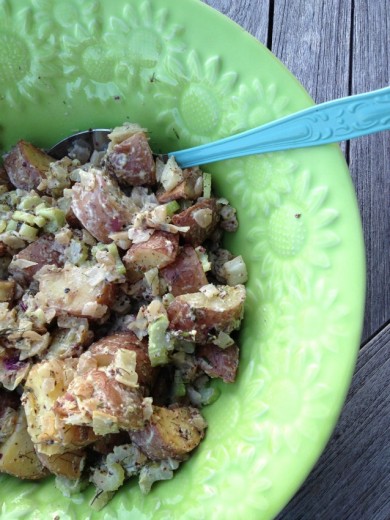
All this to say that I happened to make a potato salad last night that I really liked and hey! what do you know?, it’s Memorial Day weekend and you might need a good potato salad.  Because of my intense love of potatoes, I really like just about any potato salad.  I like them with a mayonnaise dressing and also with an olive oil one.  I like them with pickles, hard boiled egg, scallions, celery, and without any of those things.  I have even been known to eat those gloppy yellowing mayo soaked ones that you find in plastic tubs from a grocery store.  This potato salad is nothing like that kind.  I created this one as a way to highlight the flavor of the ingredients, not drown them in dressing.  And, as usual these days, I was inspired by the produce at the markets.

Boiling potatoes, especially lovely pink hued new potatoes from the Berkeley farmers’ market, is a cruel way to treat them.  It zaps all their flavor and tends to make them mushy.  Mushy potatoes don’t work well in potato salads because when you go mix everything together, they fall apart.  Their skins tend to peel off.  Much better to roast the potatoes in the oven, with a little olive oil and plenty of salt.  Then your prime ingredient tastes good on its own so it can’t help but be delicious in the finished product.  I sautéed purple spring onions and fennel with just a bit of parsley and mixed in thinly sliced celery.  I think mustard and potatoes are great friends so I made a dressing that is nice and creamy but with a lot of bite from two kinds of mustard and some horseradish. If you hate mayonnaise, and I know there are many of you out there, I imagine you could use all yogurt or sour cream instead.  I like my potato salads lightly dressed but this recipes makes plenty of it in case you want to add more or make the salad again.  It will keep for a week in the refrigerator and would be a great sandwich spread too.

Three Years Ago:  Mushrooms with White Wine
Four Years Ago:  Individual Vegetable Tarts
Five Years Ago:  Niçoise Tartines with Peperonata

Potato Salad with Fennel and Mustardy Dressing
Dana Treat Original
Serves 6-8

Spring onions look like giant scallions.  You will want to use the bulb part only (the part that looks like an onion) and discard the greens.  You could substitute a large sweet onion (like Walla Walla or Vidalia) instead.  Be sure to buy a fennel that has some of the fronds attached (the green dill like looking top) because you will stir some of the chopped fronds into the finished salad.  Make sure to dress the salad when the potatoes are warm.  They will absorb the dressing beautifully.

For the dressing:
2 tbsp. plain yogurt
2 tbsp. mayonnaise
2 tbsp. Dijon mustard
2 tbsp. whole grain mustard
2 tbsp. horseradish
Pinch of salt and freshly ground black pepper

For the salad:
2½ pounds new potatoes, scrubbed and cut into large bite-size chunks
Olive oil
3 spring onions, bulb part only, chopped
1 large fennel, inner core removed, chopped
2 tbsp. fresh parsley, chopped
4 stalks of celery, thinly sliced
2 tbsp. chopped fennel fronds

Make the dressing:
Mix together the first five ingredients in a bowl.  Taste and add salt and pepper to your liking.

Make the salad:
Preheat the oven to 375ºF.  Lay the potato chunks on a large baking sheet and drizzle with 2-3 tablespoons of olive oil.  Shower with salt and a few grinds of pepper.  (Potatoes need salt!)  Place in the oven and bake for 20-25 minutes without disturbing them.  A paring knife should easily pierce them.  Remove from the oven and let cool slightly.

Meanwhile, place a large sauté pan over medium heat.  Drizzle in just enough olive oil to coat the bottom, then add the onions and fennel and a large pinch of salt.  Cook, stirring occasionally, for about 5 minutes, then add the parsley.  Continue to cook until the vegetables are very soft and brown in places, about 10 more minutes.  Scrape the contents of the pan into a large bowl.

Transfer the still quite warm potatoes to the bowl along with the celery.  Spoon out about five tablespoons of the dressing into the bowl and, using a spatula, mix together gently.  Add the fennel fronds and mix again.  Taste for salt and pepper and additional dressing if desired.


What Grows Together Goes Together

May 16, 2013

What grows together goes together.  Are you familiar with this saying?  It is a terrific mantra when you find yourself at a farmers’ market.  Now you Northern climate people, before you close your eyes and mutter, “Enough with the bragging about California farmers’ markets”, remember that I was one of you.  I was the person who counted down the weeks until my neighborhood market started in May, and then counted down the weeks until real actual produce, not just kale and parsnips, arrived.  I was the one finally (finally!) buying English peas, snap peas, fava beans, and other green spring things in late June which is not (not!) spring.  I have been there.  And now I am here in California and I am going to talk about my glorious California farmers’ markets.  So there.

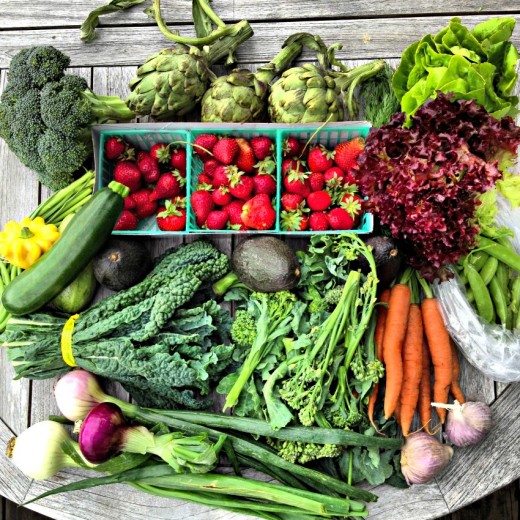
I used to hit the markets with a list.  I would plan my menu for the week and I would try to buy as much as I could at the market.  Whatever I couldn’t find there I would buy at the grocery store.  This approach led to a lot of frustration.  Walking in to a farmers’ market with a set idea of what to buy just might leave you agitated because there is not guarantee that what you want will be there.  Even if it is in season.  It is better, I have found, to just go and buy what looks good to you.  Buy what you like.  Ideas will pop into your head and since you are shopping seasonally and locally, all the things you buy will go together in some way or another.  What grows together goes together.  And if you are really a list person, bring a blank list to the market.  Once you have you have been inspired by the produce there and bought what you like, you can make a list of the things you need to fill out the dinners you have planned.

Last week, I bought a truly shocking amount of produce.  How could I not?  Everything looked so amazing.  I realized, soon after putting everything away, that Randy was going to be out of town the first part of the week and that I had better get some friends to come eat with me.  I made pizzas and a huge salad which we devoured.  I told Randy about my creations and he was crestfallen that I had made pizza, on the grill no less, without him.  So I made the same dinner, just for us, on Mother’s Day.  Yes, I cooked on Mother’s Day.  In fact, I made breakfast and dinner.  No sad trombone or tiny violins here.  I had two friends come down from Seattle last weekend and we spent all Saturday out and about in Oakland and then San Francisco, topped off with a dinner at AQ.  It was such a gift to be able to just hang with my friends and not have to worry about the boys, I wanted to thank him for giving me that time.  I also wanted to just be home with my family and enjoy pizza and wine on our deck, rather than at a busy restaurant.

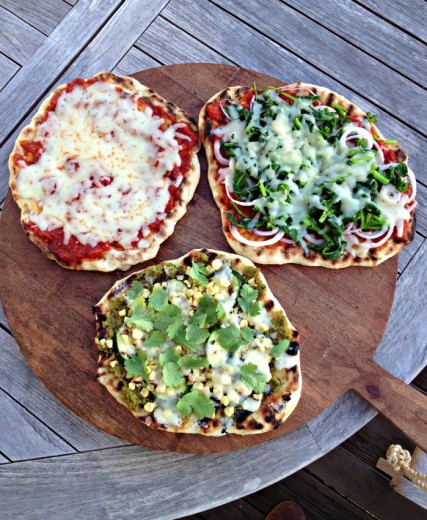
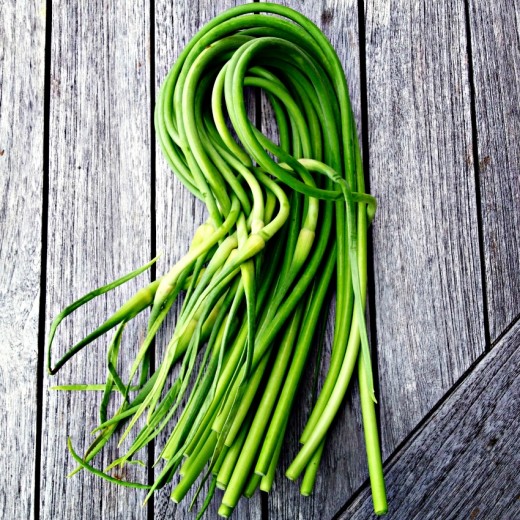
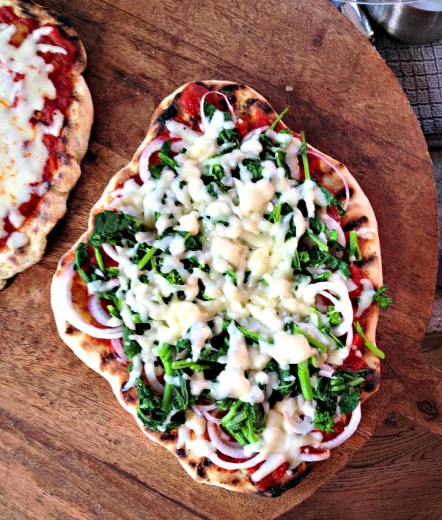
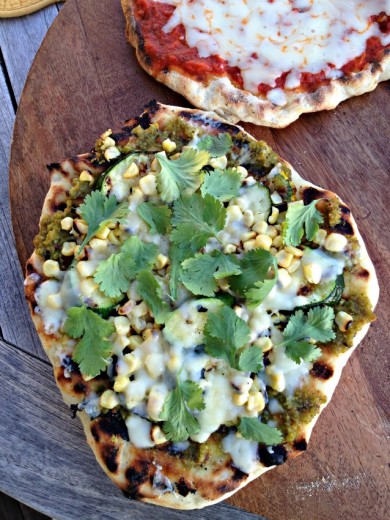
I could just have easily titled this post Put It On a Pizza.  When I end up with a surplus of fresh seasonal produce, I often end up making pizza and combining things I have on hand for a topping.  I also do this with pasta or risotto but pizza is my favorite.  Especially when I make it on the grill.  With my crazy produce haul, I had the most beautiful bunch of garlic scapes (see photo above) which I made into a pesto.  That got brushed on one pizza and was topped with grilled zucchini and grilled corn (corn in May!) and some shaved Manchego cheese.  A few cilantro leaves on top too.  I love broccoli rabe on pizza so for the other one, I blanched a bunch of that, chopped it up, and paired it with sweet spring onion rounds on a marinara slathered crust, topped with mozzarella.  When I made dinner for my family on Sunday, I repeated everything but also made a third pizza of just cheese and sauce for the boys.

I almost always use Mark Bittman’s pizza dough recipe.  It is easy and has a short rising time.  I keep promising myself that I will try others, notably the ones that have a longer rise, but the truth is that I am not always forward thinking when I make pizza.  If I realize that at 5:30 I still haven’t made the dough, we can still be eating by 7.  If you have small people who would be terrified to even contemplate anything other than a cheese pizza, divide the dough into three pieces and make one of them more plain.  I’m going to give directions for cooking pizza on the grill, since we are coming upon grilling season, but these can of course be made in a very hot oven.

One Year Ago:  Pepper Glazed Goat Cheese Gratin (I’ve made this countless times – so amazing and easy!)
Two Years Ago:  White Bark Balls
Three Years Ago: Chickpeas with Lemon and Pecorino Romano (so good!), Potato Salad with Snap Peas
Four Years Ago:  Quinoa with Grilled Zucchini and Chickpeas, Peanut Butter Cup Brownies, Raspberry Almond Bars

Pizza with Garlic Scape Pesto, Grilled Zucchini and Corn
Dana Treat Original (mostly)
Serves 4 along with another pizza (or double this recipe and make two)

You might not use all the zucchini or corn, but just throw them in a salad another night.  The pesto makes quite a bit.  It is terrific with pasta, rice, and eggs, or as a sandwich spread.  You can always take half of it, put it in a container, and freeze it for another time when garlic scapes are a distant memory.  Finally, this pizza has a LOT of flavor, so I didn’t think it needed much cheese.  But add as much as you like.  You can, of course, substitute another cheese for the Manchego.

½ ball pizza dough (recipe follows)
Garlic scape pesto (recipe follows)
2 small zucchini or other summer squash, sliced on the diagonal, about ¼-inch thick
2 ears of corn, shucked
Olive oil
Kosher or sea salt
½ cup (or more) Manchego cheese, shaved
Few cilantro leaves

Heat a grill to high.  Place the zucchini slices on one side of a rimmed baking sheet and the corn on the other.  Drizzle it all with a little olive oil and then add a healthy pinch of salt to both vegetables.  Using your hands, toss well (keep the vegetables separate).  Grill the zucchini and corn.  You will want nice grill marks on the zucchini and the corn should brown in places.  Remove back to the baking sheet.  Leave the grill on.  When the corn is cool enough to handle, slice the kernels off the cob.

Scatter a bit of cornmeal on a pizza peel (or the bottom of a baking sheet can work too).  Stretch the dough out to a nice thin circle, then place it on the peel.  Slide the dough onto the grill, close the lid, and let cook for4 minutes, or until the bottom is nice and golden brown with some grill marks.  Carefully coax it back onto the peel (tongs can be useful for this step).  If you are using an oven instead of a grill, just top the raw dough with the toppings – you won’t need to flip.

Turn the dough over and smear the top with some of the pesto going almost to the edges of the circle.  It is quite strong so you don’t need a lot.  Add the zucchini slices and the corn.  Top with the shaved Manchego.  Slide the pizza back on the grill, cover and cook for 2 minutes or until the cheese is melted and the visible dough is golden brown.  Slide back on the peel and scatter cilantro leaves over the top.  Let sit for a minute, then slice and serve.

Pizza Dough
Courtesy of Mark Bittman
Makes: Enough for 1 large or 2 or more small pies

To make pizza dough by hand or with a standing mixer, follow the directions, but use a bowl and a heavy wooden spoon or the mixer’s bowl and the paddle attachment instead of the food processor. When the dough becomes too heavy to stir, use your hands or exchange the mixer’s paddle for the dough hook and proceed with the recipe.

3 cups all-purpose or bread flour, plus more as needed
2 teaspoons instant yeast
2 teaspoons coarse kosher or sea salt, plus extra for sprinkling
2 tablespoons extra virgin olive oil

Combine the flour, yeast, and salt in a food processor. Turn the machine on and add 1 cup water and the oil through the feed tube.

Process for about 30 seconds, adding more water, a little at a time, until the mixture forms a ball and is slightly sticky to the touch. If it is still dry, add another tablespoon or two of water and process for another 10 seconds. (In the unlikely event that the mixture is too sticky, add flour a tablespoon at a time.)

Turn the dough onto a floured work surface and knead by hand for a few seconds to form a smooth, round dough ball. Put the dough in a bowl and cover with plastic wrap; let rise until the dough doubles in size, 1 to 2 hours. (You can cut this rising time short if you’re in a hurry, or you can let the dough rise more slowly, in the refrigerator, for up to 6 or 8 hours.) Proceed to Step 4 or wrap the dough tightly in plastic wrap or a zipper bag and freeze for up to a month. (Defrost in the bag or a covered bowl in the refrigerator or at room temperature; bring to room temperature before shaping.)

When the dough is ready, form it into a ball and divide it into 2 or more pieces if you like; roll each piece into a round ball. Put each ball on a lightly floured surface, sprinkle with flour, and cover with plastic wrap or a towel. Let rest until they puff slightly, about 20 minutes.

Garlic Scape Pesto
Courtesy of Epicurious
Makes about 1½ cups

I only had salted pistachios on hand so I only added a pinch of salt to the pesto.

10 large garlic scapes
1/3 cup unsalted pistachios
1/3 cup finely grated Parmigiano-Reggiano
Kosher salt and black pepper
1/3 cup extra-virgin olive oil

Puree the garlic scapes, pistachios, Parmesan, ½ teaspoon salt, and ¼ teaspoon pepper in a food processor until very finely chopped. With the motor running, slowly pour the oil through the opening. Season the pesto with salt and pepper to taste. (The pesto keeps in the fridge, covered, for 1 week or frozen for a month.)


Where I Have Been

April 5, 2013

Hello Friends.

The first quarter of 2013 is over and I have not a lot of food posts to show for it.  There are several reasons for the quiet on this site.  One is still adjusting to a new life and new rhythm in a new city.  I was far busier in Seattle and yet posted much more frequently.  More proof that the busier I am, the more productive I am.  Another reason is some technical problems with my web host and just general internet yuck.

But the main reason is that I just haven’t been feeling all that good.  I’ve never mentioned this here, but I suffer from acid reflux.  I had it bad with both of my pregnancies and after I had Spencer, it never went away.  I’ve had tests done over the years and have been able to control it very well with a mild medication.  Until recently.  For some reason that is not easily explained, my reflux got completely out of control about two months ago.  I went from falling asleep easily every night, to being up for hours trying to get the stomach pain and constant buzzing in the back of my throat (from stomach acid) to go away enough for me to doze off.  The discomfort is with me during the day too, just not as much in the front of my mind in the daylight.  I don’t feel bad all the time but much of the time.  Being in a new city, I was a little lost and finding the right person to go see was much more difficult than in my home town.

I’ve done more tests and switched medications and the bottom line is that I’ve been feeling  pretty terrible much of the time.  I am on something new that apparently takes a while to start working so I am holding on hoping that that is true.  (UPDATE: For the past couple of days, I have been feeling better.  I guess the new medicine is working after all.  Phew!) As you do in these situations, I went to Facebook and asked for advice from friends.  What are you taking?  What has worked for you?  A number of people said they had seen naturopaths and found out they had food intolerances and their reflux cleared up after they eliminated those foods.  Not really knowing what else to do, I decided to put myself on an elimination diet.  I cut out everything I thought might be giving me trouble.  Caffeine, alcohol, sugar, soy, wheat, grains, beans, dairy.  Because I don’t eat meat, that meant I was eating eggs, fruits and vegetables, quinoa, and nuts and seeds.  I did this for four weeks and I did not feel one bit better.  No change in my stomach issues, no sudden glow to my skin, no bounce in my step.  So, obviously, I have gone back to eating my regular (mostly) healthy diet.

So essentially, I have not been writing glowing posts about delicious things I have been making because my stomach has been hurting and because I have been cooking in an extremely limited fashion.  But here is the thing.  I made some tasty things, even with the restrictions I put on myself.  That polenta was a super satisfying dinner.  And I made several different kinds of Thai curry, all of them with my new favorite Kabocha squash which goes so well in curry, all of them with homemade curry paste, all of them satisfying.  I am glad that I can eat out again without worrying about what I will order and glad to have all my choices available again.  I am interested to note that I am not rushing back to certain things – sugar for one.

I used one of my favorite cookbooks, Real Vegetarian Thai, for my curry paste recipes and I have found that the red curry is much spicier than the green.  This green paste is mild but with so much flavor that I really encourage you to make your own.  It doesn’t take long at all and it will keep for up to a month in your refrigerator.  I find that, because the green is so mild, I use about half of a batch for one pot of curry, but you may use less.  If you don’t want to make your own paste but still want to make the curry, Thai Kitchen makes a decent curry paste that is vegetarian.  It is pretty spicy though so be careful adding it to the stew.  Kabocha squash is kind of round-ish and the skin can be either green or orange.  I have found that the orange ones have a better texture.  Either way, the skin is edible.  Just be really careful cutting into them!

One Year Ago:  Holly B’s Savory Brioches
Two Years Ago:  Eggplant and Mushroom Pasticcio, Lemon Cream Tart (the best lemon tart!)
Three Years Ago:  Holly B’s Cinnamon Rolls, Baked Rice with Chiles and Pinto Beans
Four Years Ago:  Spicy Sweet Potatoes with Lime, Marinated Chickpea Salad with Radishes and Cucumber

Thai Green Curry with Kabocha Squash and Shiitake Mushrooms
Dana Treat Original (curry paste from Real Vegetarian Thai)
Serves 3-4

I made this twice in two weeks.  The first time I did not use tofu because I was not eating soy.  I used a drained can of bamboo shoots to bulk it up.  I think it is better with a bit of tofu, but it is up to you.  This makes a nice thick curry.  If you want more liquid, you can add more coconut milk or even a bit of vegetable broth or water.  Finally, I used to always use low fat coconut milk in my curries but I am SO over that.  The real stuff tastes about 1000% better.

For the curry paste:
4 fresh green jalapeño chiles
1 tbsp. whole coriander seed
1 tsp. whole cumin seed
5 while or black peppercorns
3 stalks lemongrass
¼ cup fresh cilantro leaves and stems
2 shallots, coarsely chopped
4 cloves garlic, roughly chopped
1 tbsp. roughly chopped ginger or galangal
Zest of 1 lime
1 tsp. salt

For the stew:
Coconut, peanut, or canola oil
3 medium shallots, thinly sliced
1-inch piece of ginger, peeled and minced
2 garlic cloves, minced
1 red bell pepper, seeded, and cut into 1-inch pieces
6 ounces shiitake mushrooms, stems removed and thickly sliced
1 14-ounce can full fat coconut milk
1 small kabocha squash, seeded, cut into 1-inch chunks
6 ounces extra firm tofu, cut into 1-inch pieces
Handful of cilantro leaves, chopped
Kosher or sea salt

Make the curry paste:
Stem the chiles, chop them coarsely, and set aside.  In a small skillet over medium heat, dry-fry the coriander seeds until they darken a shade or two, shaking the pan or stirring often, 2 to 3 minutes.  Tip out onto a saucer.  Toast the cumin seeds in the same way, until they darken and release their rich aroma, 1 to 2 minutes.  Grind the two spices along with the pepper in a coffee or spice grinder, or in a mortar and pestle.

To prepare the lemongrass, trim away and discard any root section below the bulb base, and cut away the top portion, leaving a stalk about 6 inches long including the base.  Remove any dried, wilted, and yellowed leaves.  Finely chop the stalk.

Combine the lemongrass, the chopped chiles, and the ground toasted spices with the remaining ingredients in a blender or food processor and grind them to a fairly smooth paste, stopping often to scrape down the sides and adding a few tablespoons of water as needed to move the blades.

Make the stew:
Place a wide pot over medium heat.  Add just enough oil of your choice to coat the bottom, then add the shallots and a large pinch of salt.  Allow the shallots to cook, stirring often, until they are soft and starting to brown, about 5 minutes.  Add the ginger and garlic and cook for another 2 minutes.  Next add the red pepper and the shiitake mushrooms.  Cook, stirring occasionally, until the mushrooms and peppers are starting to soften and brown in spots, about 10 minutes.

Move the vegetables over to one side of the pot.  Pour in about ¼ of the coconut milk and then spoon in a couple of tablespoons of the curry paste.  Mash the paste into the coconut milk to combine, then stir the mixture together with the vegetables.  Pour in the rest of the coconut milk and turn up the heat.  Taste the liquid to see if you need more curry paste and add as needed.  When it comes to a boil, add the squash and the tofu.  Turn the heat down to a simmer, cover, and cook until the squash is fork tender, about 20 minutes.  Just before serving, taste for salt and shower with the chopped cilantro.  Serve with jasmine or basmati rice.


Polenta with Spicy Tomato Sauce

March 24, 2013

Thank you for all your entries into my ActiFry giveaway!  I’m so glad to hear that so many of you share my intense love of French fries.  The winner, chosen at random, is Michelle who says, “French fries and Ben & Jerry’s Red Velvet Cake Ice cream. Have to have both sweet and salty or the craving for the other would drive me crazy! Acti-Fry come live at my house!“  Congratulations Michelle!

On another note, I apologize that there is only one photo here.  For some reason I am not able to upload photos in the way I have been doing it.

I go through phases in my cooking.  Maybe you all do too.  Sometimes, I am very book focused.  I pay special attention to books I have been neglecting or those that are new to my collection.  I challenge myself with fancy dishes, dinners that take an hour or more to pull together.  Other times, I am wanting to cook from the most current issues of the magazines I receive.  Up the minute perfectly seasonal dinners with on-trend ingredients.  Sometimes I want to shop the farmers’ markets and let the produce I find there inspire me to search out new recipes from books or blogs that I trust and love.  And other times, I just want to be surrounded by things I like and figure it all out as I go.

This last option is how I’ve been cooking lately.  I know that much of the country is still in winter but Northern California is staring down the barrel of spring without really having had winter.  A walk through an East Bay farmers’ market these days will reveal citrus, avocados, strawberries, cauliflower and broccoli, tons and tons of greens, winter squashes, radishes… the list goes on and on.  It is inspiring to say the least.  I just walked through picking up things that I like, handing over a few dollars here and there, and making up dishes as I went along.  It was not precise or especially thought out.

So, with a big kabocha squash, a large head of cauliflower, some spring onions, and a bunch of other things I already had in my refrigerator or my pantry, I made three dinners.  Three meals that were nothing ground breaking, but all three were healthy, tasty, and satisfying.  I didn’t make multiple stops at the grocery store because I had already bought things I liked and just trusted that I would have enough to make good meals.  It is important for me, when I am cooking this way, to have plenty of salad greens and other goodies for the salad bowl so that even if dinner turns out a little thin, we can enjoy a big salad.

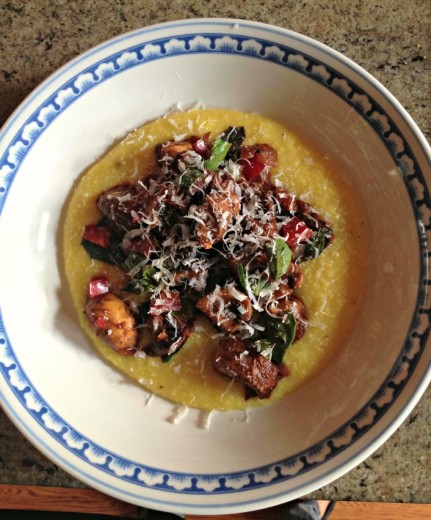
First up, I had an eggplant left over from making Eggplant Parmesan.  Eggplants keep surprisingly well and this one still felt firm and had no bruising.  It had been a while since I last made polenta and I keep seeing notes on how best to cook it.  The current thought is that you don’t have to stir it constantly and that the longer it sits, with an occasional stir, the creamier it gets.  Once it has spent about a half hour over direct heat, you can move it to a double boiler and let it stay for an hour or more.  I’ve always given my attention to polenta at the beginning of the cooking process and then more or less left it alone, but had never tried the double boiler method.  I actually found that mine got a little dried out so I will need to tweak the amount of liquid next time I try it.

I love polenta just about any way but I do think it truly shines when paired with a tomato sauce of sorts.  For this one, I made a  basic puttanesca, minus the anchovy, and added small cubes of eggplant to it.  This is the kind of sauce that can be made in big batches and squirreled away in your refrigerator or freezer for the next time you want to just surround yourself with things you like and figure it out.  I kept this dinner pretty simple but it would be divine with the addition of cheese over top (Parmesan, ricotta salata, or feta would be my picks), or even a fried egg.  This recipe will probably make more sauce than you will use for the polenta, unless you like it very saucy, so try the leftover sauce over pasta or with eggs.

Polenta with Spicy Tomato Sauce
Dana Treat Original
Serves 3-4

The full teaspoon of red pepper flakes makes this sauce nice and spicy.  If you would like yours a little more mellow, just add less.

1 cup polenta
3-3½ cups water or vegetable broth
Olive oil
Kosher or sea salt and freshly ground black pepper
1 small onion, cut in small dice
2 garlic cloves, minced
1 small eggplant, cut into ½-inch cubes
1 generous tsp. dried basil
1 tsp. red pepper flakes
1 28-ounce can crushed tomatoes
¼ cup Kalamata olives, sliced
2 tbsp. capers, rinsed and drained
Handful fresh basil leaves, sliced

Make the polenta:
Place the water or broth in a medium saucepan and bring to a boil.  Slowly pour in the polenta, whisking constantly.  It will look like there is too much liquid at first but it will start to thicken quickly.  Turn the heat down to medium-low and keep whisking until the mixture is quite thick, about 5 minutes.  Turn the heat down to low and just give the polenta an occasional whisk, every few minutes or so.  If you would like to try the double boiler method, after half an hour, transfer the polenta to a heatproof bowl.  Fill the saucepan (no need to wash it) back up with water, then heat the water to a simmer.  Place the bowl with the polenta over the simmer water and cover the bowl with a clean kitchen towel.  It can sit like this for an hour or more with an occasional stir.  If you are going to try this method, I would definitely use the 3½ cups of liquid and maybe even 4.

Make the sauce:
Place a Dutch oven over medium heat.  Drizzle in enough olive oil to coat the pan, then add the onion and a large pinch of salt.  Sauté for about 5 minutes, then add the garlic.  Cook for 1 minute, then add the eggplant, the dried basil, and the red pepper flakes.  Give it a good stir, then allow to cook, stirring occasionally, until the eggplant is tender and starting to brown in spots, about 10 minutes.  Pour in the tomatoes, add another pinch of salt, and bring the sauce up to a simmer.  Cook off some of the liquid so that the sauce is nice and thick, about another 10-15 minutes of cooking time.  Stir in the Kalamata olives and the capers and cook another 5 minutes just to bring the flavors together.  Stir in the basil right before serving and season to taste with salt and pepper.


So Good, I Made It Twice

December 13, 2012

Common sense would say that the second time you make something, it is better than the first.  Right?  The second time you know your way around the recipe, or the ingredients if you are creating it yourself, and the tinkering makes it better.  You are committed to that dish, having enjoyed it enough once to make it again, and it tastes even better.

Not always so.  At least in my kitchen.  I rarely make things twice because I have a deep need for variety in my diet.  Occasionally I make something I really like and find myself craving it soon after the leftovers are gone.  So I make it again and 89% of the time (scientific figure) I like it better the first time.  Is it because I tinker too much?  The old “if it ain’t broke, don’t fix it” idea?  Who knows.  When that happens, I either don’t write about the dish, or I do with the first run haunting me as I type.

Recently I had one of those weeks where I didn’t want to cook from recipes.  I wanted to just have fresh or freshly cooked ingredients at my disposal and figure it out as I went along.  I am not really that kind of cook.  I am a recipe cook but the years of cooking experience and finding treasures at farmers’ markets have mellowed me, and cut my reliance on hard and fast recipes.  So I spent an afternoon stocking my refrigerator with things I like and decided to just figure it all out as the week progressed.  Dinner one night was bowls filled with sautéed kale, quinoa, topped with bits of roasted squash and a fried egg.  There were more bowls filled with rice noodles, baked tofu, and bok choy.  There was a Niçoise salad or two.  At the end of the week, I made a soup whose base was a bunch of leeks I had not used and a lonely potato that was sitting on my counter.  I added what I had leftover and like most soups that are born from ingredients that you like, it was terrific.  I even ate the leftovers for lunch a couple of days later.  Me.  The leftover hater.  The next week, I still had some quinoa, so I roasted more squash, sautéed more kale, and made the soup again, assuming that it wouldn’t be as good the second time.  But it was.  So I had to post about it.

Now, I’m not going to suppose that you have cooked quinoa, roasted squash, and already sautéed kale in your refrigerator.  I would imagine that you could probably make this soup without doing any up front work.  You could add the squash along with the leeks and potatoes, allowing it to get nice and soft.  You could pour in the quinoa after the broth is boiling and I assume it would cook all right.  You could add the kale near the end, cooking it enough that it gets tender but still stays nice and green.  You could do all that and it would be good soup.  But I don’t think it would be that good.

Here is why.  Quinoa cooked properly, not in too much liquid, retains a nice texture and crunch.  Roasted squash gets nice and caramelized making it much sweeter than just cooking it in liquid.  And kale.  Well.  I don’t think I’ve ever admitted this before here but I’m not a huge fan of kale.  I cook it and I eat it because sometimes there is a need for big dark leafy greens and I like it better than chard.  But you will not find a love letter to kale here.  And yes, I have made kale chips and no, not a single member of my family thought they were anywhere near as good as potato chips, and I may have actually just dumped them in the compost bin.  Ahem.  What I have learned about kale is that I need a bit of garlic cooked along with it and a healthy pinch of red pepper flakes.  It needs to be cut in small pieces and it needs to cook long and slow until it is really tender.  It also needs to be Tuscan or lacinato kale, which is much more tender than its cousins.  So precooked kale, made just the way I like it, worked really well for me in this soup.

Can I call this a chowder?  Does chowder mean that there is cream involved?  Chowder means chunky to me so I’m going to call it that.  And as for the extra squash and kale that will be left after the soup is gone?  Use them in risotto, pasta, on top of pizza, stuffed in a sweet potato, or shoved into an omelet.

One Year Ago:  Posole Verde, Chocolate Chip Cookies
Two years Ago:  Brown Rice Bowl with Marinated Tofu, Snickerdoodle Cupcakes, Healthier Mac and Cheese
Three Years Ago:  Holly B’s Stollen, Spicy Tomato Jam, Sweet and Salty Cake (I’m making this next weekend)
Four Years Ago:  Breton Apple Pie, Oatmeal Raisin Cookies, Lemon Rice Rolls with Lemon Tahini Sauce

Potato and Quinoa Chowder with Winter Squash and Kale
Dana Treat Original
Serves 4

I used red quinoa here because I had some I like the color better than the regular stuff.  The regular stuff will work just fine here, your soup will just be a bit more monochromatic.  Delicata squash is my squash of choice because you don’t have to peel it and they tend to be smaller than butternuts.

Olive oil
3 leeks, white and pale green part only, cut in half, washed, then thinly sliced
1 large baking (russet) potato, cut into ¾-inch cubes
1 large carrot, peeled and cut into small dice
Leaves from 4 lemon thyme branches (or regular thyme)
6 cups vegetable broth
1 cup cooked quinoa (recipe follows)
½ delicata squash, cut into 1-inch pieces (recipes follows)
½ bunch sautéed kale (recipe follows)
Kosher or sea salt and freshly ground black pepper

Place a large-ish soup pot over medium-low heat.  Drizzle in enough olive oil to coat the bottom of the pot, then add the leeks along with a large pinch of salt.  Stir frequently until they start to soften, about 4 minutes.  Be careful with them as they can burn easily.  Add the potato and carrots and allow to cook for another 5 minutes, stirring occasionally.  Add the lemon thyme, cook for another minute, then pour in the broth.  Bring to a boil, then lower the heat to a lively simmer and cook until the potato and carrot are very tender, about 20 minutes.

Add the quinoa, squash, and kale to the soup pot and bring the heat up so the soup really simmers.  Allow to cook for 10 minutes so that the added ingredients warm up and the flavors of the soup really meld together.  (Soup can be made up to 3 days ahead.  It will thicken considerably, so add broth or water to it as you reheat it.)

To make quinoa:
Bring 1½ cups water to a boil.  Add quinoa, then lower heat to simmer and cover the pot.  Cook for 15 minutes, then remove lid.  (This will make a bit more than you need for the soup.  You might even want to increase the amount so you have some extra hanging around.  Just use 1½ the amount of water to the amount of quinoa.)

To make roasted squash:
Preheat oven to 425ºF.  Split squash down the middle and scrape out the seeds.  Slice each half into half moons about ½-inch thick and lay them out on a rimmed baking sheet.  Drizzle with olive oil and sprinkle with salt.  Roast in the oven for 15 minutes.  Remove and turn all the slices over.  Roast for another 7 minutes.  Remove and allow to cool.  Can be stored in the refrigerator for up to 5 days.

To make the sautéed kale:
Wash a large bunch of kale.  Strip the leaves off the stem, you can do this just using your hands or you can slice them off with a knife.  Chop the leaves into 2-inch pieces.  Heat a large sauté pan over medium-low heat.  Drizzle in just enough olive oil to coat the bottom of the pan, then add two minced garlic cloves.  Immediately add a large pinch of red pepper flakes.  Just as the garlic is starting to turn light brown, add all the kale leaves.  It will look like a lot but, like all greens, it will cook down.  Stir frequently and add a bit of water if the kale is sticking.  Taste to make sure the kale is really soft, it can take up to half an hour for me to get it where I want it, then remove from the heat.  Can be stored in the refrigerator for up to 5 days.


« Older Posts