




Category: International

One More Cookbook Down

April 27, 2010

As my overflow cookbook shelf is starting to overflow, I decided to go through my cookbooks and weed out a few that I never use.  Just out of curiosity, I decided to do a quick count and was a little surprised to find that I own 122 cookbooks.  How did that happen?

I do love them all, even the ones I never use, so the thought of getting rid of some was difficult.  In looking through them, I realized I was faced with a dilemma – what if a cookbook has one truly great recipe, but that one recipe is the only one I use or even like in the book?  Do I hang on to it or give it away?

One of my cookbooks in this category has an incredible Moroccan Tagine recipe that I have made countless times.  Everything else in the book feels so overwrought, so over-flavored that I have given up on the rest of the recipes.  Vegetarian food often has one of two faults – either it is severely under flavored (think brown rice and overcooked vegetables), or the food has 12 too many different tastes going on in any one dish.  This book’s recipes fall firmly in that second camp.

I decided to challenge myself.  Could I make a tagine based on my tastes, my knowledge of food, and my memory?  I have made that recipe and others like it many times, couldn’t I just re-create it?  If so, the book is out of here.

I was compelled to set this challenge for myself not only because of my cookbook real estate situation, but also because I ended up with a large amount of leftover couscous after Friday’s party.  I made the couscous to be served in endive spears.  The recipe actually suggested serving it in those Asian soup spoons but seeing as I don’t have 55 of those on hand, endive it was.  Each spear was topped with a scoop of buttery orange-scented and currant-studded couscous and a dollop of plain yogurt spiced up with curry powder.  The dish was a hit, I just ran out of endive so the leftover couscous came home with me.  I had no doubt about what to make to serve with it – a tagine.

A tagine is Moroccan in nature and is often made with lamb or chicken.  It can also be made with fish.  And it can, of course, be made vegetarian.  A tagine actually refers to the vessel in which the stew is traditionally cooked, one that is shaped kind of like an upside down funnel.  The thinking is that the broad base and the narrow top allows very little steam to escape so meat gets exceptionally tender and the flavors are allowed to really harmonize.

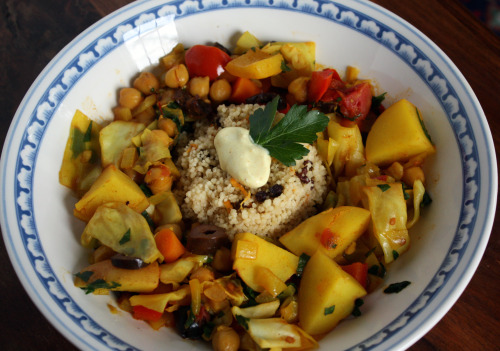
I don’t have a tagine (although don’t think I haven’t eyed them at Sur la Table) so I use a large heavy Dutch oven with terrific results.  For this one I used a mixture of carrots, potatoes, canned tomatoes, bell peppers, and chickpeas.  The spices I did by taste memory – cumin, coriander, tumeric, paprika and saffron.  I like heat so I added a bit of cayenne too.  One of the thing I love about tagines is their mixture of salty and sweet so I used a few Kalamata olives and chopped prunes.  You can use raisins, dates, or even dried apricots for that bit of sweetness.

I guess I don’t have to tell you that I love this tagine – otherwise I wouldn’t be writing about it, right?  It is just what I wanted so I suppose it’s time to ditch that cookbook.  Fresh fennel and sweet potatoes would be good substitutions or additions, I would just be sure to keep the carrots and potatoes.  I like my tagines to be on the brothy side so that the couscous gets a good soak, so add more water as necessary.  Like most stew-y things, the flavors here improve with age so don’t hesitate to make it a day ahead.  I would just wait to add the parsley until just before serving, or add more to get that green pop.

One Year Ago:  Sushi Rice Salad (a favorite of mine)

Tagine with Carrots, Potatoes, and Olives

Dana Treat Original
Serves 4

This may look overwhelming, but many of the ingredients are spices and really, it’s just a bunch chopping and a lot of letting the deliciousness happen on its own.

1 large onion, diced
2 tsp. ground cumin
1 tsp. ground coriander
½ tsp. tumeric
½ tsp. paprika
Large pinch of cayenne pepper
Pinch of saffron threads
2 large carrots, cut into ¼-inch thick slices
3 medium red potatoes, cut into 1-inch pieces
1 red pepper, seeded and cut into 1-inch pieces
1 yellow pepper, seeded and cut into 1-inch pieces
1 14-oz. can diced tomatoes
1 14-oz. can chickpeas, drained
1/3 cup Kalamata olives, coarsely chopped
3 large prunes, coarsely chopped
¼ cup chopped parsley

Heat a large Dutch oven over medium heat.  Add just enough olive oil to coat the bottom and then add the onions and a large pinch of salt.  Sauté until the onion starts to soften but not brown.  Add the spices and stir to coat the onions well.  Add the potatoes and carrots and give a good stir.

Cook for five minutes, stirring often so the spices don’t stick to the bottom and burn.  Add the peppers and the tomatoes.  Take the can the tomatoes were in, fill it halfway full of water and add that to the pot as well.  Stir and turn up the heat so the mixture comes to a boil.  Lower the heat to medium-low and cover.  Cook for 10 minutes, then add the chickpeas, olives, and prunes.  Cover again and cook until the vegetables are tender, about another 15 minutes.  About 5 minutes before serving, add the parsley.  Serve over couscous with a dollop or Curried Yogurt on top.

Orange-Scented Couscous with Curried Yogurt
Adapted from Bon Appétit

2/3 cup plain whole milk yogurt
½ – ¾  tsp. curry powder

1 cup vegetable broth
¾ cup couscous
1 tbsp. butter
Zest of ½ a large orange
2 tbsp. orange juice
¼ tsp. ground cinnamon
½ cup currants

Mix yogurt and curry in bowl.  Cover; chill.

Bring broth to a simmer in small saucepan.  Mix in couscous.  Cover; set aside until couscous is tender and broth is absorbed, about 10 minutes.  Use a fork to fluff up couscous, then mix in (using fork) butter, orange juice, orange zest, and cinnamon, then currants.  Season with salt and pepper.


A Love Affair with Red Lentils

February 21, 2010

IMG_4782_picnik

Variety is a big part of my diet.  In the three years I worked as a personal chef, I only repeated recipes a handful of times, and those were requests.  I figure I love food and love to eat and I want to make as many different things as I can in my lifetime.  Of course, I have my go-to meals but I really do try and have variety in our food lives.

And then there are the things that I could eat every single day and be totally happy.  Good french fries with ketchup.  Noodle soups like this one, noodle dishes like this one (yes, I have a thing for Asian noodles) could fulfill me until the end of my days.  And any kind of red lentil dish is on that list too.

If you have never cooked with red lentils, you are in for a treat.  They are among the fastest cooking of beans and they change utterly and completely from raw to cooked.  Raw they are bright orange (in spite of their name) and look like flat pebbles.  Cooked they become a mellow yellow and they lose their shape.  Depending on how much liquid is in your dish, they can loosely resemble other lentils, or they can disappear completely.  They, like other lentils, are high in protein and fiber, yet low in calories and fat.  They require no pre-soaking time.

On Thursday, I crossed the Sound and did a cooking lesson for a group of extraordinary women.  We have been talking about doing a class for months and I gave serious thought to what I wanted to cook.  In the end, I decided to make a full meal and it took me about one second to decide to feature a red lentil dhal.

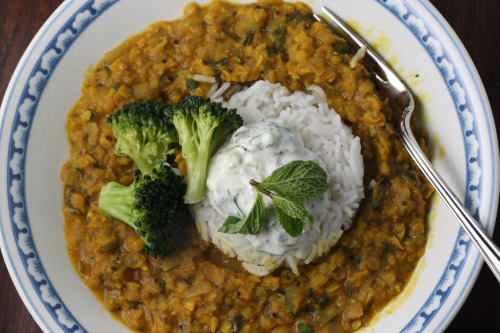
Because I love red lentils and I love this family of spices, I have made various incarnations of this dish many times over the years.  Of all the ones I have made, this is my favorite.  It is very highly spiced – not hot, just spicy.  One of the beauties of this dish is its adaptability.  You could add all manner of vegetables (carrots, potatoes, zucchini, spinach come to mind).  Or you could add more liquid, allow it to simmer away and turn it into a soup.

IMG_4787_picnik

Red Lentils Previously on Dana Treat: Curried Red Lentil Stew with Vegetables
One Year Ago: Double Baked Chocolate Cake

Red Lentil Dhal
Inspired by The Modern Vegetarian
Serves 4-6

This list of ingredients is long but much of it is spices.  The stew actually comes together quite quickly.

Vegetable oil or grapeseed oil
2 tsp. cumin seeds
2 tsp. black or yellow mustard seeds
1 medium onion, finely diced
1 ½ inches of fresh ginger, peeled and minced
2 garlic cloves, minced
1 jalapeno chile, seeded, finely chopped
1 ½ tsp. curry powder
2 tsp. ground cumin
1 tsp. tumeric
Pinch of chile powder
1 tbsp. tomato paste
2 cups red lentils
2 cinnamon sticks (or 1, if large)|
2 cups water
1 15-oz. can “lite” coconut milk
Sea salt
Juice of 1 lemon
A bunch of mint, chopped
A bunch of cilantro, chopped

Heat just enough oil to coat the bottom of a large pan and add the mustard and cumin seeds.  Be careful as they will begin to pop.  Immediately add the onion, adjust the heat to medium, and cook until softened – about five minutes.  Add the ginger, garlic, chile, curry powder, cumin, tumeric, and chile powder and fry for 3 minutes.  Add the tomato paste and fry for 1 minute.

Add the lentils and stir to coat with the oil and spices.  Add the cinnamon stick, water, and coconut milk.  Bring to a boil, then reduce the heat so the dhal is at a simmer.  Cover partially and cook, stirring occasionally so it doesn’t stick to the bottom, until the lentils have partially lost their shape and are soft – about 15 minutes.  Stir in more liquid as necessary for the consistency you want.

Remove from the heat, season with sea salt and add the lemon juice to taste.  At this point, you can allow the dhal to cool and then cover and refrigerate it overnight.  When reheating on the stove, you will need to add more liquid as it will thicken as it sits.

About 10 minutes before serving, add the herbs.  You will want them to cook down a bit but not so much that they lose their color.  Serve warm over basmati rice and with a raita if desired.


Peanut Curry for the Hungry Days

November 20, 2009

IMG_3843

The downside to having well over 100 cookbooks is that you tend to overlook old favorites in favor of shiny new toys.  I have my books stored as follows:  one cabinet houses two shelves of the high rotation favorites, one shelf houses international cookbooks, one has baking books, a separate somewhat annoying-to-get-to shelf is reserved for the lesser used books, and a kitchen counter houses all the overflow.  In my high rotation cabinet sits The Essential Vegetarian Cookbook.  It isn’t sexy or fancy but it has some of my favorite recipes.  Most of the dishes in this large book are healthy but substantial.  A winning combination if there ever was one.

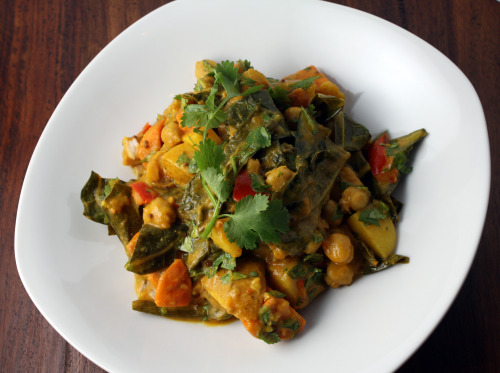
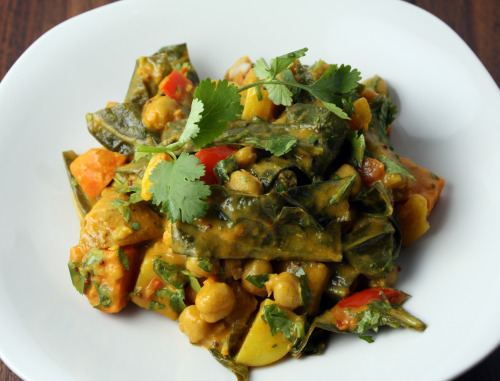
You know those days where you could just eat all day long and never feel full?  Where nothing is really satisfying?  That is the kind of day to make this curry.  It is incredibly hearty without being too rich and it is so healthy with all kinds of vegetables and beans.  I serve mine on a bed of rice and with a dollop of yogurt on top, but you could easily leave that out and keep it vegan.  The spices here are intoxicating and there is just enough peanut butter here to make it interesting but not so much as to be overwhelming.  If you are wanting to make that naan, it is a perfect accompaniment to this stew.

IMG_3838

One Year Ago:  Brussels Sprout Hash with Caramelized Shallots and Parmesan and Thyme Crackers

Peanut Curry with Sweet Potato and Collard Greens
Adapted from The Essential Vegetarian Cookbook
Serves 4 generously

I know this is a long list of ingredients but it actually comes together quite quickly.  I have substituted spinach for the collard greens here with good results.

2 tsp. canola or vegetable oil
1 large onion, chopped
One 2-inch piece fresh ginger, peeled and grated
4 garlic cloves, minced
1 tbsp. ground cumin
2 tsp. whole mustard seeds
2 tsp. ground coriander
1 tsp. ground tumeric
1 tsp. paprika
1/4 tsp. cayenne pepper, or more to taste
1 red bell pepper, chopped
1 large sweet potato, peeled and chopped
1 pound Yukon Gold potatoes, cut into bite size pieces
2 large tomatoes, seeded and chopped
1/2 14-ounce can lite coconut milk, or more to taste
2 tbsp. smooth peanut butter
1 large bunch collard greens, stemmed and coarsely chopped
1 14-ounce can chickpeas, rinsed and drained
1/2 cup cilantro leaves, chopped

Heat the oil in a large skillet over medium-high heat.  When it’s hot, add the onion and cook until softened and starting to brown, about 8 minutes.  Add the garlic and ginger and cook 1 minute, stirring constantly.  Add all the spices and cook for another minute, then add the red pepper, the potatoes, the sweet potato, and the tomatoes.  Cover and let simmer over medium-low, until the potatoes have cooked through, about 15 minutes.

Stir in the coconut milk and peanut butter.  Add the collard greens and the chickpeas and stir well to combine.  Cook until the collard greens have wilted down enough to be soft, about 15 minutes.  If the curry seems to thick, add more coconut milk or water to thin it.


Thai Green Curry

September 10, 2009

IMG_3243

I may be the last person in the food blogging world, but I have joined a CSA. It’s something I have been meaning to do for years but didn’t for a variety of reasons. One of those reasons is the overwhelming number of choices to make. We are fortunate to have an abundance of farmers’ markets and an abundance of farmers in the Pacific Northwest and choosing one farm from which to get magnificent produce…it was too much for me. Give me a few good choices and I’m very good at making decisions. Give me too many choices and I shut down.

A few weeks ago I decided enough was enough and took the plunge with Nash’s Organic Produce. One of the many reasons I chose them is that you get a box from them from June through December. Spring is usually a cold and rainy season for us, so if you were to visit a farmers’ market in May, what you would find is a lot of lettuce and some apples. Eventually all manner of peas make their way to the stalls and then there are the berries which are truly glorious and start late June. But for me, the really exciting stuff doesn’t start until August and even September. That is why I am thrilled that we have weeks and weeks ahead of us to get incredible quantity, quality, and variety from Nash’s.

Oh, but how to use all that amazing produce? It’s a good exercise for me actually. After years of menu planning for my clients and having my shopping list done every Friday, it’s nice to have some freedom and some creativity with what I cook. It’s also a challenge but a good challenge.

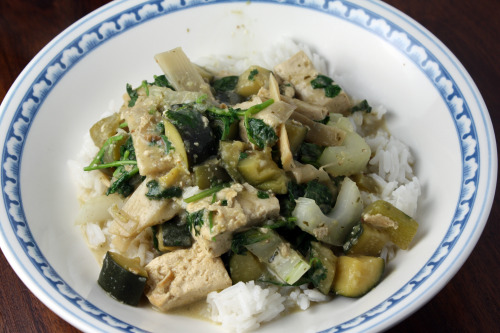
This week, the first thing I saw when I opened the box was bok choy. Asian food was a no brainer. There were also a couple of green peppers in there so I immediately thought of green curry. I turned to my trusted Real Vegetarian Thai cookbook and proceeded to make my own green curry paste and get some tips on how to turn it into dinner. There is a recipe for a green curry dish in there, but it is pretty spartan so I made it my own.

IMG_3250

Thai Curry previously: Winter Vegetables with Thai Red Curry

UPDATE: Based on some of the comments, I have a few things to update here. If you are not familiar with the term, a CSA is a share in a farm (it stands for Community Supported Agriculture). You pay them money up front and then you get a box of produce from that farm for a given number of weeks. Every farm handles it differently but most do not allow you to choose what you get. It’s like getting a little surprise Christmas box each week. In the curry recipe, do not hesitate to use “lite” coconut milk. I almost always use the lower fat lower calorie stuff in my cooking.


Thai Green Curry Paste
Adapted from Real Vegetarian Thai
Makes about 1 cup

If you are afraid of spice, do not fear, this paste isn’t really hot. I recommend scraping the seeds and membranes out of the chiles to keep things under control. If you love heat, leave the seeds in all or half the chiles.

5 fresh green serrano chiles or 4 fresh green jalapeño chiles
1 tbsp. whole coriander seeds
1 tsp. whole cumin seeds
3 stalks lemongrass
1/2 cup coarsely chopped cilantro leaves and stems
1/4 cup coarsely chopped shallots
2 tbsp. coarsely chopped garlic
1 tbsp. coarsely chopped fresh ginger
Zest of 1 lime
1 tsp. salt
1/2 tsp. ground black or white pepper

Stem the chiles, scrape out the seeds and membranes, and chop them coarsely. Set aside. In a small skillet over medium heat, dry-fry the coriander seeds until they darken a shade or two, shaking the pan or stirring often, 2-3 minutes. Tip out onto a saucer. Toast the cumin seeds in the same way, until they darken and release their rich aroma, 1-2 minutes. Add to the saucer along with the coriander, then grind the spices to a fine powder in a mini food processor or coffee grinder. Set aside. You can substitute the same amount of ground spices, dry-frying them together for a minute or two and stirring often to prevent burning.

To prepare the lemongrass, trim away and discard any root section below the bulb base, and cut away the top portion, leaving a stalk about 6 inches long, including the base. Remove any dried, wilted, and yellowed leaves. Finely chop the stalk.

Combine the lemongrass, the chopped chiles, and the ground toasted spices with the remaining ingredients in a blender for mini processor and grind them to a fairly smooth purée, stopping often to scrape down the sides and adding a few tablespoons of water as needed to move the blades. Transfer to a jar, seal airtight, and store at room temperature for up to 1 day, or refrigerate for up to 1 month.

Thai Green Curry with Zucchini and Peppers
Dana Treat Original
Serves 3-4

You can, of course, use jarred curry paste here. If you are vegetarian, just be sure to check the label – sometimes they contain shrimp paste. Thai Kitchen’s brand is decent. Jarred paste tends to be very strong, so use a small amount and add more if you need to.

Peanut oil
1 large shallot, cut into thin rings
1 large green pepper, cut into 1″ pieces
2 medium zucchini, ends trimmed, quartered, and sliced into 1″ pieces
12 oz. extra firm tofu, cut into 1″ cubes
1 -5oz. can sliced bamboo shoots, drained
1 -14 oz. can coconut milk
2-3 tbsp. green curry paste
1 tbsp. brown sugar
1 tbsp. soy sauce
4 stalks of a large bok choy, or 2 baby bok choys, stalks thickly sliced and leaves coarsely chopped
1/4 cup cilantro leaves, chopped

Heat a large skillet or Dutch oven over medium heat. Add just enough peanut oil to coat the bottom, then add the shallots. Allow to cook for 3-4 minutes, until just beginning to brown. Add the green peppers and cook, stirring often, for 8-10 minutes, or until the peppers are very soft and starting to brown. Add the zucchini, bamboo shoots, and tofu and cook until the zucchini is soft, about another 5 minutes.

Meanwhile, pour about 1/3 of the coconut milk into a small saucepan and heat just until hot. Stir in the curry paste and, using a spoon, mash it into the coconut milk. Once it is combined well, add it to the vegetables and tofu, stir well, then add the rest of the coconut milk to the pot. Add the brown sugar, the bok choy stems, and the soy sauce. Stir everything together, lower the heat, and allow to cook until the flavors are well blended, about 15 minutes. A few minutes before serving, stir in the cilantro and the bok choy leaves. Allow to wilt slightly. Serve over jasmine rice.


Muhummara Dip

July 29, 2009


img_2956

There are certain dishes that just pop up for me again and again.  Things that I love and I keep trying variations until I find the one that becomes “my” version.  I’m thinking of things like baba ghanoush and gazpacho.  I tried endless variations before I settled on the Greens cookbook’s and Cook’s Illustrated’s versions respectively.

Muhummara is one of those things.  What?  Something you may have not even heard of and here I am tracking down the perfect recipe?  Here is the thing.  I love dips.  Not like chips and dip (although I love those too), I mean like warm grilled pita bread and dip.  If a restaurant has some kind of Middle Eastern platter, I will without question order it.  I love hummus, baba ghanoush, tzatziki, and I love muhummara.  Well, now I do.

I have made four or five versions of this dip and always liked it.  It just never popped for me.  Eralda at The Split Pea recently posted a recipe that looked a little different from the ones I have tried.  I decided to make for last weekend’s lunch and everyone who tried it loved it.  I served it with crackers, but it would be great with pita and Eralda says it’s terrific with cucumber.  This is my new go-to recipe.

img_2950
One Year Ago:  Creamy Eggplant with Green Peas


Smokey Muhammara

Adapted from The Split Pea

I made a few changes here, mostly in method.  I also cut down on the amount of garlic because I don’t like a lot of raw garlic in my dips.  You can find pomegranate molasses at Whole Foods and at Middle Eastern markets – if you are lucky enough to have one of those where you live.  It’s flavor adds so much to this dip, so it is worth seeking out.  Along those same lines, the smoked paprika is essential here.  The flavor will just not be the same with regular paprika.

3  red bell peppers
1 cup of walnuts
¾ cup of pecans
1 ½ tsp. cumin
2 tsp. sweet smoked paprika
1 1/2 tsp. ground Chipotle Chile powder (or regular chile powder)
2 cloves garlic
1 ½ tsp.  salt
2 tsp. olive oil
Juice of 1 lemon
1 tsp. of honey
2 -3 tbsp. pomegranate molasses (substitute balsamic vinegar)

Preheat the oven to 500°F.  Place the peppers on a baking sheet and roast, turning occasionally, until beginning to blacken in spots, about 15 minutes total.  Remove sheet from the oven and carefully wrap it in foil.  Allow to sit for 10 minutes, then remove the foil.  When the peppers are cool enough to handle, peel away the skin and remove the membranes, stems, and seeds from each pepper.  Slice and place in food processor.

Lower the oven temperature to 350°F. Place the walnuts and pecans in a rimmed cookie sheet and toast for about 3-5 minutes until fragrant (oven temperatures vary, so make sure to keep an eye on them).  Set a timer so you don’t forget about them.  Remove from the oven and allow to cool.  Once cool, add to the food processor along with all the other ingredients.  Process until smooth, scraping the sides of the bowl as necessary.  Taste for balance of flavor, adding more salt, honey, or lemon juice as necessary.  If the dip seems too thick, add more olive oil.

Keeps refrigerated for up to 3 days.


« Older Posts