




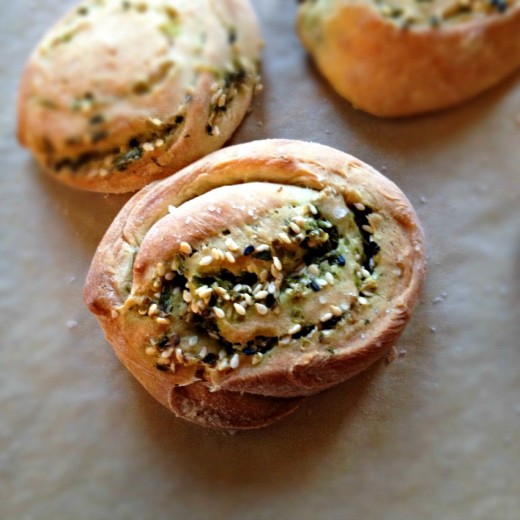
Category: Bread

The Last Food Blogger on Earth

March 15, 2010

IMG_4738_picnik

Folks, it’s true.  I am the last food blogger on Earth who has not made Jim Lahey’s No-Knead Bread.  Okay, well maybe not the last,  but I am one of the last.

I’m intrigued by it though and having tasted it (my lovely neighbor Julie is a convert), I can tell you that all the fuss is well-deserved.  I bought the cookbook, I have the right size pot, now I just need to bake it.  (I don’t think I will write about it though – haven’t we all read enough about no-knead bread?).

IMG_4756_picnik

I decided to make another of Lahey’s much-praised recipes for my first foray into his world.  Pizza Bianca is one of those things where you look at the list of ingredients and think – that’s it?  Or at least I do.  But then I remember that my very favorite part of any pizza, even bad pizza, is the crust.  So why not just one giant crust?

To be fair, this is meant to be more of a flatbread than a crust.  I imagine Lahey’s vision is somewhere between a foccacia and a pizza crust.  I think what I made is a little closer to a foccacia and I didn’t quite get the dimpling technique right, but it was still really delicious.  I cook and bake a lot but I have to say that pizza dough is not my specialty.  I know that I just need to make it more regularly to get a better feel for the dough.  (Did you hear that?  That is Randy cheering in the background.)  I am excited to try more of his pizza recipes in addition to that famous bread.

IMG_4759

One Year Ago: Chocolate, Hazelnut, and Ginger Biscotti and Tropical Gazpacho

Pizza Bianca

From My Bread
One 14-inch pie

3 cups (400 grams) bread flour
¼ tsp. (1 gram) instant or other active yeast
½ tsp. (4 grams) table salt
¾ tsp. (4 grams) sugar
1½ cups (350 grams) cool (55 to 65°F) water
¼ cup (60 grams) extra virgin olive oil, plus additional for coating the bowl and brushing
½ tsp. (4 grams) coarse sea salt
3 sprigs fresh rosemary

1.  In a medium bowl, stir together the flour, yeast, table salt, and sugar.  Add the water and, using a wooden spoon or your hand, mix until you have a wet, stick dough, about 30 seconds.  Lightly coat a second medium bowl with olive oil and place the dough in it.  Cover the bowl and let sit at room temperature, until the surface is dotted with bubbles and the dough is more than doubled in size, 9 to 12 hours.

2.  When the first rise is complete, generously dust a work surface (a cutting board is useful here) with flour.  Use a bowl scraper or rubber spatula to scrape the dough out of the bowl in one piece; as you begin to pull it away from the bowl, it will cling in long thin strands and will be quite loose and sticky.  Using lightly floured hands, fold the dough over itself two or three times and nudge it into a loose, rather flat ball.  Brush the surface of the dough with olive oil as sprinkle with the coarse salt (which will gradually dissolve on the surface).  Put the dough in a warm, draft-free spot and let rise until doubled, 1 to 2 hours.

3.  Half an hour before the end of the second rise, preheat the oven to 500°F, with a rack in the center, and place a pizza stone, at least 14 inches in diameter, in the center of the rack.

4.  Generously dust a pizza peel with flour and place the ball of dough in the middle.  Spread out the fingers of one hand, like a claw, and drive your fingers into the dough but do not puncture it.  You want to simultaneously create dimples in the dough and spread it out across the peel.  Continue working your hand across the dough and dimpling it until you have a bumpy disk about 12 inches in diameter.  Drizzle the remaining olive oil over the top and sprinkle with the rosemary leaves.

5.  With the peel resting on the counter, grasp the handle and give it a quick little tug; you want the pizza to just barely move but stay on the peel.  (Loosening it makes it easier to slide it onto the baking stone.)  If the dough sticks to the peel, gently lift it around the edges and add flour to the peel.  Shake the pizza onto the baking stone.  Bake for 12 to 15 minutes, until the crust is golden brown on the mounds but still pale in the dimples.

6.  Slide the peel under the pizza and transfer it to a rack to cool for at least a few minutes before slicing and serving.


Category: Bread
Permalink | Print Print | 21 Comments

Holly B’s Pesto Parmesan Cornbread

February 10, 2010

IMG_4622

So what do you serve with chili?  Kind of silly, right?  Kind of like asking, “What do you serve with peanut butter on bread?”  In case you are not catching my drift – cornbread is what you serve with chili.  Oh and beer.  Duh.

The question becomes, which cornbread?  I already have two favorites but I thought it was time to try a third recipe.  If you want very full-flavored cornbread with lots going on, I can whole-heartedly recommend Ina’s version.  It is the one to make for a crowd since you will end up with a ton of it.  But if your appetite is more on the delicate side, I wouldn’t use that recipe.  It’s a meal in and of itself.

I thought I would try Holly B’s recipe and jazz it up by doing the Pesto Parmesan option listed in the book.  The nice thing is that the pesto stays in a small area so I could taste the bread on its own as well to truly asses where it stands in my cornbread book.  The verdict?  Very delicate and cakey.  So much so that as Randy went to take a bite, it basically crumbled right into his chili, which isn’t necessarily a bad thing.  I liked baking it in a pie dish and that each wedge had a little dollop of pesto at its end.  I also liked the Parmesan sprinkled over top.  Maybe I’ll try that with my other favorite version which comes from The Joy of Cooking.  Recipe coming some time soon.

IMG_4628

One Year Ago: Chocolate Chip Cupcakes

Holly’s Favorite Corn Bread
With Love & Butter
Makes 8 wedges

¾ cup stone ground cornmeal
1 cup flour
1 tbsp. baking powder
1 tbsp. honey
¼ tsp. salt
1 cup milk
1 egg
½ cup (1 stick) butter, melted
8 tsp. pesto
¼ cup freshly grated Parmesan cheese

Preheat the oven to 375°F with the rack in the middle of the oven.  Butter a 9- to 10-inch glass pie plate.

Place all the ingredients except the pesto and cheese in a medium bowl and mix, by machine or by hand, until just combined.  Scrape down the bowl once or twice.  Smooth the batter into the pie dish.  Evenly blob 8 teaspoons of pesto around the edge of the batter, so that each wedge of cornbread will show a bit of green at the base.  Scatter the whole dish with the Parmesan.  Bake 15 minutes, rotate the dish, and bake for 5 to 10 minutes more or until the top is light brown and a toothpick comes out easily.  Cut into 8 wedges and serve.


Flat Bread (not Flatbread)

February 4, 2010

IMG_4576

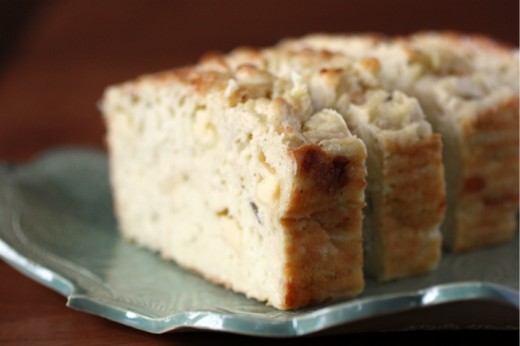
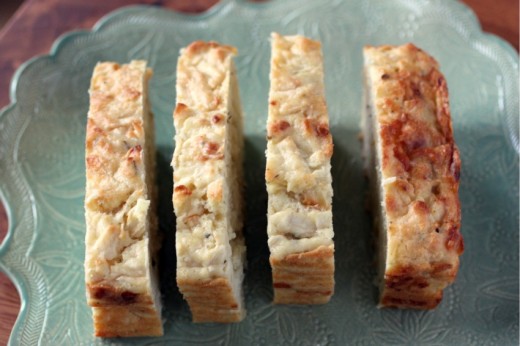
If I happened upon this blog and saw this photo, I would assume it was biscotti.  You know, when you take the log from the oven to start slicing it into cookies.  It is not biscotti; it is bread.  Bread that did very little rising.  Why?  I’m really not sure.  This is why people are afraid to work with yeast.  Yeast can be mysterious.  I have a feeling that it just wasn’t warm enough in my kitchen for it to do its thing.  Usually when I am baking bread, I turn on my oven to a very low heat and then turn it off and prop the door open for a minute or two.  That nice little warm haven is perfect for rising dough.  I skipped that step this time.

Why am I sharing a recipe for flat bread that is not supposed to be flat?  Simple.  It tasted really good.  Like if it had risen appropriately, I might have found my perfect bread.  I am a total sucker for olives and absolutely love them in bread.  For this particular recipe, you make a Biga starter which is nothing more than some flour, yeast, and water.  You will have more starter than you need for one loaf, so why not double the bread recipe and make two?  Put one in the freezer and one on your table.  And if yours rises, send me a photo.

IMG_4579

One Year Ago: Roasted Orange Pepper Soup

Olivetta Loaf

Macrina Bakery and Café Cookbook
Makes 1 oval loaf

The recipe originally suggests you bake this bread on a pizza stone.  I found the dough so wet and sticky that I would have been unable to get it onto the stone.  It also suggests you do a final shaping step that I was also unable to do due to stickiness.  Just keep your flour handy, do what I did, and the bread will taste great.

5 ounces Traditional Biga Starter (recipe follows)
1 cup water, at room temperature
¼ tsp. dried yeast
2¾ cups all-purpose flour
1/3 cup olive oil
1 tsp. chopped fresh rosemary
1 tsp. chopped fresh oregano
2 tsp. kosher salt
¾ cup green olives, pitted and halved

Combine starter, water, and yeast in the bowl of a stand mixer.  Using the paddle attachment, mix on low speed for 1 minute.  Add flour, ¼ cup of the olive oil, herbs, and salt, and mix on low speed until ingredients are combined.  Switch to the dough hook attachment and mix on medium speed for about 10 minutes.  Dough will start forming a ball around the hook.

This dough is quite wet, so give your hands a generous dusting of flour before working with it.  Pull dough from bowl on to a floured surface and form into a 6 x 10-inch rectangle, positioning dough so that a short end is facing you.  Sprinkle olives over entire surface of dough.  Starting with the closest end, roll dough away from you into a log.  Make sure log is resting on its seam, then fold the ends underneath to form a loosely shaped ball.  Place ball of dough in an oiled medium bowl and cover with plastic wrap.  Let proof in a warm room, 70 to 75°, for 2 to 2½ hours.  Dough should double in size.

Pull dough from bowl onto a floured surface and gently flatten it with your hands to release excess air.  Form flattened dough into an oval shape by folding the left and right sides onto the top.  Place loaf, seam side up, on a very well floured floured rimmed baking sheet.  Sprinkle top of loaf with flour and cover with a dish towel to keep it from drying out.  Let proof in a warm room for about 1½ hours.  Loaf will rise slightly and be soft to the touch.

While loaf is proofing, preheat oven to 385°F.

Uncover dough dimple lightly with your fingers, and place baking sheet in oven.  Bake for about 45 minutes.  The finished loaf will have a reddish brown color and will sound hollow when tapped on the bottom.  Let loaf cool on a wire rack for about 20 minutes, then brush top with more olive oil.

Traditional Biga Starter
Makes approximately 2½ pounds of starter

2 cups water, at room temperature
1½ tsp. dried yeast
2½ cups flour

Pour water into a medium bowl and sprinkle yeast on top.  Mix with a whisk until all lumps are dissolved.  Add flour and mix with whisk until smooth, about 3 mintues.  Place uncovered bowl in a warm room, 70 to 75°, and let sit for 2 to 3 hours.  Bubbles will appear on the surface of the biga.

Cover the bowl with plastic wrap and transfer to the refrigerator for at least 6 hours.  It is during this time that the starter will truly develop its flavor.  Bigas can be stored in the refrigerator for up to 4 days.  So it does not taste too sour, it is best to use it within 2 days.


Category: Bread
Permalink | Print Print | 11 Comments

Yogurt Flatbread (Naan)

November 19, 2009

IMG_3860

If you don’t own Deborah Madison’s Vegetarian Cooking for Everyone, I would highly recommend you put it on your holiday list.  The book is ten years old but it has recently been re-issued for its’ anniversary.  Whether you are vegetarian, vegan, meat-eating, or gluten-free, you will find untold treasures in this book.  It’s the one book I would bring to a desert island without question.

I’ve used it countless times in the past but seeing as it houses about 1,400 recipes, there are so many amazing recipes still waiting to be discovered.  A few months ago Ele posted about Ms. Madison’s Naan recipe and somewhere in my clouded foggy mommy brain, I filed it away for the next time I made a curry.  It is a testament to her post (and to her lovely blog in general) that I actually only remembered it.  I received some collard greens in our CSA box last week and decided to make a favorite – Peanut Curry.

As is often the case when I am about to make bread, I took a look at the recipe and almost punted.  I don’t know what it is about bread baking that sometimes seems so onerous to me.  I certainly cook and bake things that take a lot more work.  If I hadn’t been bringing dinner to a friend in need, I probably would never had made this naan and that would have been a shame.  Friends, this is sooo good.  And sooo easy.

A few notes.  Ele said she always grills hers.  I neglected to file away that fact in my clouded foggy mommy brain and now can’t wait to make it again so I can try it grilled.  Instead I followed Madison’s instructions and used a pizza stone.  Still awesome.  I bought both the wheat bran and ghee called for in the recipe because I have a grocery store nearby where those things are easily found.  I’m sure you could substitute butter (I would melt it and cool it slightly – or you can make your own ghee) and whole wheat flour for the wheat bran.  Finally, you must brush each bread with a little melted butter and sprinkle it with sea salt when it comes out of the oven.  Sublime.

IMG_3858

One Year Ago:  Giant Chocolate-Toffee Cookies

Yogurt Flatbread (Naan)
Adapted from Vegetarian Cooking for Everyone
Makes 8 to 10 small breads

1/4 cup warm water
2 1/4 tsp. (1 envelope) active dry yeast
3/4 cup hot water
3/4 cup yogurt, preferably whole milk (DT: I used low fat)
1/4 cup or clarified butter
1 1/2 tsp. salt
1 cup whole-wheat flour
1/4 cup wheat bran
3 cups all-purpose or bread flour
1/2 stick butter, melted
Sea salt

Sprinkle the yeast over 1/4 cup warm water in a small bowl and set aside until foamy, about 10 minutes.  Meanwhile, combine 3/4 cup hot water, the yogurt, ghee, and salt in a bowl , then stir in the yeast, whole-wheat flour, and bran.  Work in enough white flour to form a heavy smooth dough, then turn it out and knead, adding more flour if needed, until smooth but slightly tacky.  Put the dough in a n oiled bowl, turn it to coat the top, then cover and put in a warm place until doubled in bulk, about 1 hour.

Preheat the oven to 450°F with a pizza stone or a sheet pan on the bottom rack of the oven.  Turn out the dough onto a lightly floured counter and divide into 8 or 10 pieces.  Roll them into balls, cover wtih a towel, and let rest for 10 minutes.

Here are two options for shaping the dough:

1.  Pat the dough into a circle using your fingertips to dimple it all over.  Then gently pull it in opposite directions to make a dimpled oblong.  The texture will be uneven, providing crisp and bready parts.  Place right on the baking stone or hot sheet pan and bake until browned on top, 12 to 15 minutes.

2.  Pat or roll the dough into a circle about 1/4 inch thick.  Make five short knife cuts, radiating from the center like a sand dollar, then transfer to the baking stone and bake until browned.

(DT: I shaped my breads using option #2.  I was able to bake two at a time on my stone.  As each pair came out of the oven, I brushed the tops with melted butter and sprinkled them liberally with sea salt.)


Category: Bread
Permalink | Print Print | 20 Comments

Some of the Best Bread You Will Ever Eat

October 27, 2009

IMG_3590

Everyone who is afraid of making bread, please raise your hand.

Well, I wish I could see you and then I wish I could come into your kitchen, hold your hand, and make this bread with you.  There are a few reasons for this.  One, after my experience last week, I’d love to meet more people who read this blog.  Two, I would like to help dispel the myth that bread is scary and hard to make.  Three, I would love to share the joy and wonder that is bread baking.  And four, maybe you would let me take some of the bread home because mine is all gone.

IMG_3589

I know – yeast.  Eeeek!  But it does. not. have. to. be. so!  I have made this bread countless times and it always turns out perfectly.  It has nothing to do with my experience or any kind of “magic” – it’s just a terrific recipe and it’s easy.  Really.

The one thing you will need here is time.  This bread has four rising times, the longest being two hours and the shortest being ten minutes. The process will take five hours from beginning to end but almost all of that is rising time.  Your hands-on time (like with most bread) is maybe half an hour and even that is split into small increments.  Take advantage of one of those rainy days where you are just home and take the leap.  Maybe you are also making a big pot of soup or a lasagna or something that is going to keep you in the kitchen for a few hours.  The dough will keep you company while you work.

IMG_3653

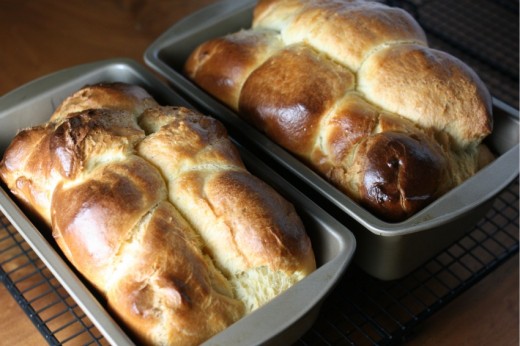
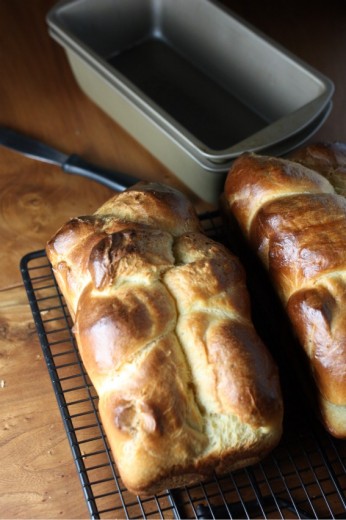
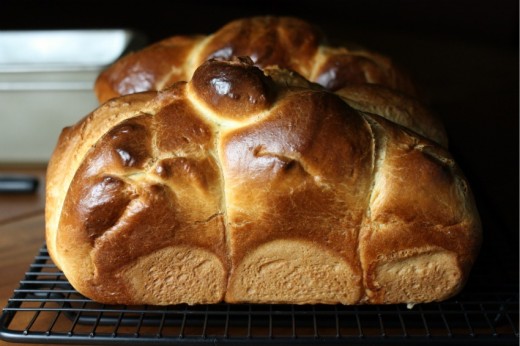
And at the end of it all you get two gigantic loaves of the most fragrant, soft yet dense, and slightly sweet bread you can imagine.  It freezes incredibly well so you can enjoy one loaf and save the other for another time.  My very favorite way to eat it is completely plain – it’s that good.  But it also makes terrific french toast, bread pudding and grilled goat cheese sandwiches which you then serve with homemade Tomato and Leek soup.  Recipe for that one coming soon.

A couple of notes.  I use my Kitchen Aid mixer to make this dough.  I use the paddle attachment to mix everything together, and about halfway through adding the flour, I switch to the dough hook.  Once all the flour is added (and I think 6 cups is just about spot-on), I let it mix for about 5 minutes.  Dough that is sufficiently kneaded should feel like your ear lobe. A perfect place to let your dough rise is in the oven.  Turn it on to it’s lowest setting and then turn it off after just a few minutes.  Just that little bit of heat (plus no draft) will make it nice and cozy in there.  When you need to heat the oven to bake the bread, place the loaves on the stovetop where they will still get residual heat.

IMG_3598

Braided Challah
Adapted from Food and Wine
Makes 2 large loaves

2 packages active dry yeast
1/2 cup lukewarm water (about 110°)
1/3 cup sugar, plus a pinch
1 stick (4 ounces) unsalted butter, thinly sliced, plus 2 tablespoons, melted
1 cup milk
1 tbsp. honey
2 1/2 tsp. salt
4 large eggs, at room temperature
About 6 cups bread flour
1 large egg plus 1 large egg yolk and 1 tbsp. water

1.  In a small bowl, dissolve the yeast in the lukewarm water with the pinch of sugar and let stand until creamy and starting to bubble.  In a medium saucepan, combine the sliced butter and the milk.  Warm over low heat just until the butter melts. Stir in the remaining 1/3 cup of sugar and the honey and slat.  Pour the milk mixture into a large bowl and stir in the dissolved yeast and the 4 eggs.

2.  Stir in just enough of the flour, 1/2 cup at a time, to form a dense dough that doesn’t stick to the side of the bowl.  Turn the dough out onto a lightly floured surface and knead until smooth and elastic, adding only as much flour as necessary to keep the dough from sticking.

3.  Brush a large bowl with 1 1/2 tablespoons of the melted butter.  Transfer the dough to the buttered bowl and brush the top with the remaining 1/2 tablespoon of melted butter.  Cover the bowl with plastic wrap and a kitchen towel and let rise in a warm, draft-free spot until the dough is doubled in bulk, about 2 hours.

4.  Punch down the dough, then cover and let rise again until doubled in bulk again, about 1 1/4 hours.

5.  Line 2 large rimmed baking sheets with parchment paper.  On a lightly floured surface, divide the dough in half.  Cover one half with plastic wrap and divide the other half into  3 equal pieces.  Using lightly floured hands, roll each piece into a 10-inch long rope with tapered ends.

6.  Arrange the 3 ropes side by side pointing toward you and just touching.  Starting in the middle and working toward your body, braid the ropes together, bringing the outside ropes over the center one.  Pinch the ends to seal and tuck them under.  Turn the loaf around and repeat with the other half, this time braiding the outer ropes under the center one.  Seal the ends, tuck them under and transfer the loaf to a prepared baking sheet; gently plump the loaf with your hands.  Repeat with the remaining dough.  Cover the loaves with kitchen towels and let rise for 35 minutes.

7.  Preheat the oven to 375°F.  Mix the remaining egg, egg yolk, and tablespoon of water together to make a glaze.  Brush the loaves with the egg glaze.  Let stand uncovered for 10 minutes, then brush again with the glaze.  Bake the loaves in the upper and lower thirds of the oven, switching the pans halfway through baking, for 35-45 minutes, or until they are golden, feel light when lifted and sound hollow when tapped on the bottom.  Loosely cover the loaves with foil if they become too brown during baking.  Transfer to a rack and let cool thoroughly before slicing.


« Older Posts