




Category: Dana Treat Original

What is Your Comfort Food?

October 17, 2012

Comfort food.  What does that mean to you?  For some it means food from their childhood.  For others it means food that is homey and simple.  Others would say it means the most decadent unhealthy thing you can eat.  As with most things food-related, there is no absolute definition of comfort food – it is different things to different people.

For me, comfort food is something I dearly love that I don’t eat all that often.  And when I do eat it, it makes me very happy.  It feels warm and nourishing but it is not something that I will regret eating the next day.  French fries would fit the bill except for that last part.  I would probably include the things that my mom used to make (flank steak, bbq chicken, meatloaf, stuffed cabbage, fried sole) but I don’t eat those things anymore.

So I offer up polenta.  Very cozy, somewhat nourishing, kind of special without being fussy.  For me, it’s a joy to eat.  Especially when there is fresh corn in the mix.  Polenta made with just cornmeal can get a little oatmeal-y on me.  Let me explain.  I like my oatmeal salty not sweet.  Brown sugar, raisins, maple syrup – none of those things are welcome in my bowl of oatmeal.  Salt only.  There is exactly one other person I know of on earth who eats oatmeal this way and he is my father and he taught me that oatmeal should be salty.  So, when I tuck into a big bowl of oatmeal, it tastes so very good at first.  I rejoice in the first few bites.  And then I get bored.  The texture is a bit gloppy and the flavor is very one note – salty.  Kind of like polenta.  I serve myself a big bowl and I am so happy for a few moments and then it starts to feel gloppy and salty – like oatmeal.

Not, however, if you add the kernels from two ears of corn and a dollop of ricotta cheese.  It becomes something much more complex.  The corn adds sweetness and crunch and the cheese adds richness but not so much that you regret eating it the next day.  Really, I would have been very happy eating it all by its lonesome but I saw a recipe for a bowl of polenta with tomato fennel broth that was topped with wild mushrooms and greens, and it was one of those where I basically stopped all my cooking plans so I could make it.  Except that I couldn’t get fennel at my small local grocery store and I’m not all that into the wild mushrooms I can find here (I miss my chanterelles!), and greens felt like they would mute my dish, so I went in another direction.  I used the corn cobs and lots herbs to make a flavorful broth, which I cooked long enough to reduce down and concentrate flavors.  I bought cremini and shiitake mushrooms, both of which keep their shape nicely and bring earthiness without weirdness to the bowl.  Yes, you will dirty three pots making this dish.  Sorry about that.  You won’t notice after the first bite.

One Year Ago:  Arugula Salad with Asian Pear and Roasted Onions
Two Years Ago:  Cranberry Soup with Farro, Graham Cracker Pound Cake, Roasted Pear Salad with Chèvre and Fig Vinaigrette
Three Years Ago:  Creamy Blue Cheese Dressing, Holly B’s Cappuccino Bars
Four Years Ago:  White Beans with Tomatoes and Sage

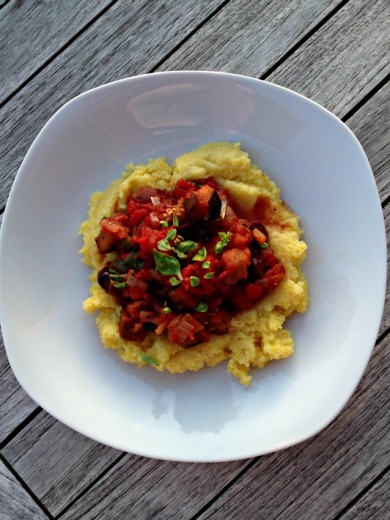
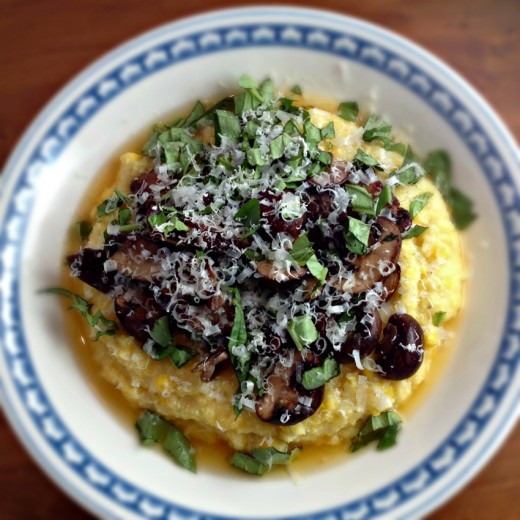
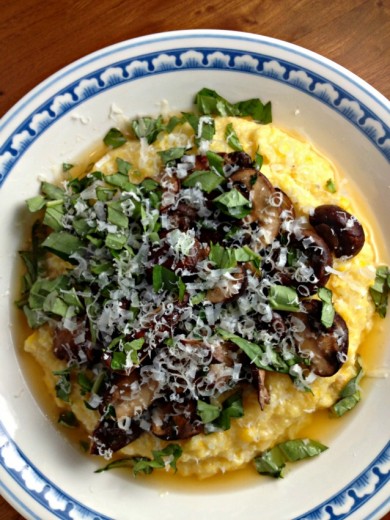
Fresh Corn Polenta with Tomato Corn Broth and Mushrooms
Dana Treat Original
Serves 4

For the broth:
2 corn cobs
½ onion
3 garlic cloves, peeled
3 parsley sprigs
2 thyme sprigs
1 bay leaf
6 peppercorns
1 tsp. kosher or sea salt
4 roma tomatoes, roughly chopped
4 cups water

For the polenta:
4 cups water
1½ cups polenta or medium cornmeal
1 tsp. kosher or sea salt
Kernels from 2 ears of corn
¼ cup ricotta cheese
Freshly ground black pepper

To finish:
1 tbsp. butter
1 tbsp. olive oil
1 pound cremini mushrooms, stems removed, slice in half
½ pound shiitake mushrooms, stems removed, slice in half
1 tbsp. thyme leaves
Kosher or sea salt
Freshly ground black pepper
½ cup (or more) basil, cut in thin ribbons, for garnish
½ (or more) cup freshly grated Parmesan cheese, for garnish

Make the broth:
If you haven’t already, cut the kernels off the two ears of corn.  Set the kernels aside in a bowl.  Place the cobs, onion half, garlic cloves, parsley and thyme spigs, bay leaf, peppercorns, salt, and tomatoes in a soup pot.  Pour in the water.  Bring to a boil over high heat.  Reduce to a lively simmer and continue to cook, stirring occasionally, until the liquid has reduced to about 1½ cups, about 45 minutes.  Pour through a fine mesh strainer into a smaller pot.  Press on the solids in the strainer to extract the juices.  Cover the broth and set aside.  (This can be made earlier in the day.  Reheat it when you are ready to use it.  You will want it nice and hot.)

Make the polenta:
Pour the water or broth into a pot that has nice high sides.  Bring to a boil.  Slowly drizzle in the polenta, whisking constantly.  It will seem like too much liquid for the amount of polenta, but the liquid absorbs pretty rapidly.  Turn the heat to low.  Continue whisking until the mixture is very thick, just about 5 minutes.  Make sure the heat is on low and allow to cook, stirring often, for 10 minutes.  It will bubble thickly and may mess up your stove, the higher the sides on our pot the better for reducing mess.  After 10 minutes, stir in the fresh corn kernels.  Cook for another 5 minutes, stirring often.  Stir in the ricotta cheese and allow it to cook for another few minutes so that the flavors can meld.  Season to taste with pepper and salt.  Cover and it should keep warm for about 30 minutes or so.  If you need to reheat it, you can do so gently over very low heat.  Be sure to stir it well so it doesn’t stick to the bottom of the pot.

Finish the dish:
Place a large skillet over medium-high heat.  Melt the butter, add the olive oil, and add the mushrooms.  Allow them to cook without disturbing them for a few minutes so they can get a bit of a sear.  Then stir occasionally as they cook for another 5-10 minutes.  About halfway through the cooking time, add the fresh thyme leaves and a good pinch of salt.  Once the mushrooms are nicely browned, season to taste with salt and pepper.

Spoon a healthy portion of polenta into 4 shallow bowls.  Top with the mushrooms, fresh basil, and a shower of Parmesan cheese.  Carefully ladle the broth around the very edge of the bowl, so it moistens the polenta without making the mushrooms soggy.


Hold the Lettuce

August 21, 2012

Hey, you know what?  I love salad.  I bet you didn’t know that.  I bet I’ve never said that.  I bet you couldn’t tell from the 55 salad recipes on this site.  I bet you couldn’t.

I would say that every single time I cook, I make a salad as well.  Sometimes I only make salad.  Salad, salad, salad.  Ahem.  Most of the time I use lettuce.  Very occasionally I use spinach.  Sometimes I don’t use a leafy green at all.  Which brings me to this stunner.  I bought zucchini at my farmers’ market because I couldn’t get this dish out of my mind but I ended up taking it in a different direction.  Also I didn’t have any burrata.  Also I was trying to cook through things in my pantry and refrigerator.

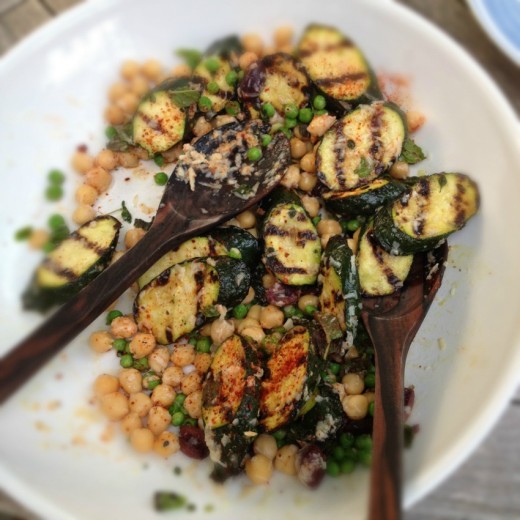
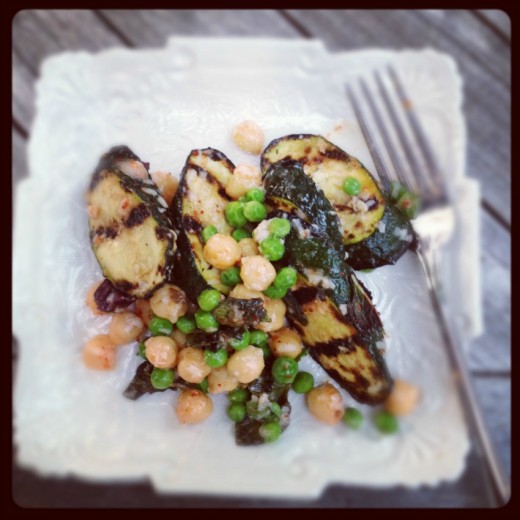
So I grilled slabs of zucchini, shelled peas, chopped up kalamata olives, drained chickpeas, grated Pecorino cheese, and chopped mint.  I put everything in a big bowl and tossed it with a little olive oil and the juice of a lemon.  I sprinkled Piment d’Espelette over the top and was prepared to really like the whole thing.  With the exception of zucchini, those are all ingredients that I use to boost flavor in other dishes.  Chickpeas round out pastas and soups in my house, mint can be surprising in Asian food, Pecorino tastes great with eggs, fresh peas add a nice pop to leafy salads, and olives are welcome just about anywhere.  So I expected to like all my favorites together in one bowl.  I guess I just wasn’t prepared for how tasty this was.  Nutty, smoky, sweet, very savory.  I can’t wait to make it again.


One Year Ago:  Radicchio Tart; Orecchiette with Roasted Tomatoes and Corn; Summer Potatoes Stewed with Eggplant, Peppers, and Olives; Pilaf with Vermecelli, Chickpeas, and Apricots
Two Years Ago:  Roasted Eggplant Caponata, D’Lish Peppadew Peppers, Chard and Saffron Tart, Vanilla Cake with Strawberry and Cream Frosting
Three Years Ago:  Mixed Berry Spoon Cake
Four Years Ago:  Succotash

Grilled Zucchini Salad with Chickpeas, Mint, and Pecorino Romano
Dana Treat Original
Serves 4-6

Usually I say frozen peas are just as good as fresh but not in this case.  You want crunch as well as sweetness.  If you can’t get fresh peas, I would buy a couple handfuls of snap peas and thinly slice them on the diagonal.  If you don’t have Piment d’Espelette you can either just grind a bit of black pepper over top or, for a bit of smokiness, sprinkle a bit of smoked paprika over top.

3 large zucchini, thickly sliced on a diagnonal
Olive oil
Kosher or sea salt
¾ cup kalamata olives, halved
1 can chickpeas, rinsed and drained
½ cup shelled fresh English peas
Leaves of 2 large sprigs mint, thinly sliced
1 cup freshly grated Pecorino Romano cheese
Juice of 1 lemon
Several pinches Piment d’Espelette

Heat a grill to high.  Place the zucchini slices in a large bowl.  Drizzle with a liberal amount of olive oil and a few pinches of salt.  Grill the slices until they are soft and have visible grill marks.  Make sure to flip over half way through.  Take the slices off the grill and return them to the bowl.  Allow them to cool slightly, then add the olives, chickpeas, and peas.  Toss gently and allow to cool to room temperature.  Then add the mint, cheese, and the lemon juice.  Toss carefully to combine.  I found I had enough olive oil from the zucchini for my taste but add more if your salad needs it.  Sprinkle the Piment d’Espelette over top.


Home Sweet Quinoa

July 20, 2012

Do not adjust your screen.  Yes that is food.  And yes there is a recipe at the end of this post.

I made dinner most nights we were in France.  When I first saw the kitchen and its equipment in the Cagnes-sur-Mer place, I assumed we would eat dinners out.  Two burners, one of them very small, and three pots, none of them bigger than a 3 quart.  One big bowl, one wooden spoon, one spatula, and a handful of duller-than-dull knives (thankfully, I brought a knife with me).  But after getting used to my tiny kitchen, I found making dinner each night to be lovely.  Pleasantly easing into the evening after a busy day of laying on the beach or exploring beautiful French towns.

I made things that were relatively quick and easy.  It was hot so I tried to keep my time in front of the stove at a minimum and I never turned on the oven.  I made a giant salad every night and sometimes I just ate that with a big hunk of bread.  I also kept it simple because I didn’t want to buy a bunch of ingredients that I would just have to leave behind.

So, we ate Mediterranean for a month.  And it was awesome.  But I missed Mexican, Asian, and Indian food.  The first thing I made when we got back was a rice dish.  I could have made risotto in France but I didn’t and I was craving rice like crazy by the time we got home.  Also – quinoa.  I found quinoa there but somehow it just didn’t seem like the right thing to cook there.  I’ve made it several times since we’ve been home.

Now, I love quinoa but I don’t love it by itself and I don’t love it just boiled away in water.  It is a very charming seed (not a grain!) but it needs a little help.  I find I like it best made more as a pilaf.  I sauté shallot rounds in a little butter, stir in the quinoa, then pour in a bit of white wine.  I cook it until the wine is syrupy, then add the water.  I have found that if you add just 1½ times the liquid as you have quinoa, it turns out great.  (So for a cup of quinoa, I add ½ of wine and 1 cup of water.)  It is not mushy and has that slight and delightful crunch.

What else is going on in that bowl?  Red lentils, cooked just enough that they are soft but not so much that they lose their shape.  Ricotta salata, one of the world’s most charming cheeses.  A little crushed red pepper.  Lots of mint.  Lots of lemon juice.  A little olive oil.  Two additions I think would be lovely are pea shoots or broccoli rabe, the former blanched and finely chopped, the latter sautéed in olive oil, sprinkled with more red pepper flakes, and finely chopped.

One Year Ago:  Lemony Chickpeas and Oven-Dried Tomato Stew, Savory Spinach, Feta, and Peppadew Muffins, Salted Caramel Squares
Two Years Ago:  Chocolate Pavé, Roasted Cauliflower with Tomato, Dill, and Capers
Three Years Ago:  Blasted Broccoli, Gnocchi with Mushroom Sauce, Asparagus Ragout
Four Years Ago:  Green Goddess Salad with Romaine, Cucumbers and Avocado (pardon the terrible photos)

Quinoa with Red Lentils, Ricotta Salata, and Mint
Dana Treat Original
Serves 6-8

If you have never used ricotta salata, you are in for a treat.  It is very salty but still mild in flavor and has a nice texture.  Similar to feta but drier and the flavor is not as gamy.  You could use feta instead.  Don’t worry about the exact amount, a small wedge will do fine.

1 tbsp. unsalted butter
3 large shallots, peeled and thinly sliced
Kosher or sea salt
½ tsp. red pepper flakes
1 cup quinoa
½ cup dry white wine
1 cup red lentils
5 ounces ricotta salata
1 small bunch of mint, leaves stemmed and coarsely chopped
Juice of 2 lemons
2 tbsp. olive oil
Freshly ground black pepper

Place a medium (3 quart is perfect) saucepan over medium heat.  Melt the butter, then add the shallots along with a pinch of salt.  Stir in the red pepper flakes and cook until the shallots are brown in spots, about 5-7 minutes.  Stir in the quinoa, make sure it is coated with the butter and shallots, then pour in the wine.  Cook, stirring frequently, until the wine is mostly absorbed, then pour in a cup of water.  Bring to a boil, cover and reduce the heat to low.  Cook for 15 minutes, or until the liquid is completely absorbed.  Scrape the quinoa out into a large bowl.

Rinse out the saucepan, then pour in the lentils and cover them with cold water.  Bring to a boil, add a large pinch of salt, then reduce the heat to keep it at a lively simmer.  Scrape off any white foam that comes to the surface.  Cook just until the lentils are tender, avoid having them go mushy, about 10-12 minutes.  Drain and add to the quinoa.

Once everything is cool (room temperature is fine), stir in the olive oil and the lemon juice, a pinch of salt and some black pepper.  Crumble in the cheese and fold in the mint.  Season to taste with salt and pepper.  This salad will keep and taste great the next day, but the mint might turn black.


Editing is Important

April 25, 2012

Part of cooking well, like dressing well, is knowing when to edit.  There is a point where the dish is close to being just right and you can either just trust that it is good, or you can keep adding to it and potentially ruin it.  I think this is a particular danger with vegetarian food.  Without the protein anchor, sometimes it might feel like you need to keep adding layers of flavor to make up for what is “missing”.  Too many layers of flavor is my main critique of Seattle’s vegetarian restaurants and why I almost never frequent them.

A dish doesn’t have to have a whiz! bang! pop! to be lovely.  I first got this idea from Tracy and her Angel Hair Pasta with Arugula and Lemon.  Every so often a dish sticks in my overstuffed brain and lately it has been this one.  As we were driving back from our decadent weekend in Walla Walla, I started dreaming of superfine pasta stuffed to the gills with arugula.  I had recently bought some angel hair in a lovely package and we were lucky enough to visit a goat cheese farm while in Walla Walla and had purchased some delightful mild feta.  I decided that, rather than make Tracy’s dish to the letter, I would just riff on it.

As it turns out, my dish is not much like hers.  That is what you get when you don’t actually consult a recipe you are trying to riff on!  But we loved this light and sunny pasta and it came together in no time.  I put some small cherry tomatoes in the oven to roast, got my pasta going, then satuéed shallots and red pepper flakes in a bit of olive oil.  I grated in the zest of a Meyer lemon and then waited for the pasta to cook.  Once it was just shy of al dente, I scooped it into the pan with the shallots and added lemon juice, lots of arugula, small cubes of feta, and the roasted tomatoes.  I used the pasta cooking water to loosen the sauce.  As I was tossing it all together, my mind was saying, “Olives! Pine Nuts! Parmesan!”, but I was able to edit and keep it simple.

One Year Ago:  Brown Sugar Pound Cake (I’ve probably made this cake more than any other)
Two Years Ago:  Zucchini and Olive Salad
Three Years Ago:  Ricotta Calzones with Sausage and Broccoli Rabe

Pasta with Lemon, Arugula, and Roasted Tomatoes
Dana Treat Original (but thanks Tracy for the inspiration)
Serves 2-3

My noodles were actually more like a cross between angel hair and spaghetti, so I’m suggesting you use spaghettini in the recipe below (it’s a thinner spaghetti).

Olive oil
20 small cherry tomatoes
Kosher or sea salt and freshly ground black pepper
1 large shallot, finely diced
½ tsp. red pepper flakes
Zest and juice of 1 Meyer lemon
4 ounces feta cheese, cut into small cubes
4 ounces arugula, plus more for garnish
8 ounces spaghettini

Preheat the oven to 375ºF.  Place the tomatoes on a small baking sheet.  Drizzle with olive oil and sprinkle with salt and pepper.  Roast in the oven until they soften, brown in spots, and start to collapse a bit, about 20 minutes.  Set aside.

Meanwhile, place a large skillet over medium heat.  Drizzle in just enough olive oil to coat the bottom of the pan, then add the shallots, red pepper flakes, and a large pinch of salt.  Sauté, stirring frequently, until the shallots soften and start to brown in spots, about 5 minutes.  Grate in the lemon zest and turn off the heat.

Meanwhile, bring a large pot of salted water to boil, then add the pasta.  Cook according the package directions until just al dente.  Taste it to make sure.  Using tongs, transfer the pasta to the skillet with the shallots.  Turn the heat to low and stir to coat the pasta with the shallots and pepper flakes.  Ladle in some pasta cooking water to loosen the sauce.  Add half of the arugula and keep tossing the pasta so that the arugula wilts.  Add the other half of the arugula along with the lemon juice, feta cheese, and the tomatoes.  Add more cooking water if the pasta seems too dry.  (You can also use olive oil if you prefer.)  Toss carefully.  Serve each portion topped with more of the arugula.


Sunday Night Chinese Food

April 17, 2012

My parents are both Jewish and both from New York.  That means that, on a lot of Sundays, we ate Chinese food.  There were different places we went, some in Seattle proper, some on the little island suburb where I grew up.  No matter which restaurant we went to, several things remained constant.

First it was the tea.  My parents would let us drink tea with as much sugar as we wanted in it.  I think it was the late 70′s/early 80′s version of an iPad.  Something to distract us three kids so that they could attempt to have a conversation.  We would pour and pour and pour that sugar until it was a thick slurry at the bottom of the little tea cups, and then we would spoon it up like soup.  And then there was soup – wonton soup to be exact.  Those little perfect parcels in burn-your-tongue hot broth, just waiting for my teeth to burst them open.  I was always disappointed by the small ratio of wontons to broth.  I could have eaten 50 of them.  My parents always ordered “bean curd” which only they enjoyed since we three thought it was disgusting.  If only my ten-year old self had known how much I would grow to love tofu!  And finally, pork fried rice.  (Yes, Jews eating pork.  We were far from the only ones.)

Here is where I admit that I had never, until last night, made fried rice.  Here is also where I admit that the word “fried” scares me.  You will not find much fried stuff here.  I don’t make donuts and I can count on one hand the number of times I have deep fried.  I am scared of the technique, the mess, and the amount of fat in the food that is fried.  That last reason is why I never order fried rice in a Chinese restaurant, truthfully why I don’t often eat in Chinese restaurants.  (This is a gross generalization but I find Chinese food, in Seattle anyway, to be much greasier than other Asian food.)

Here is why I went for it.  I’ve been making this tempeh for my Spanish cooking classes.  It goes in the paella.  It is so good that, after the class is over and I am washing countless dishes, my fingers keep sneaking into the almost empty pot, hoping that some previously uncovered piece of tempeh will appear.  Doing this search reminded me of the pork fried rice of my childhood and how I would clumsily attempt to get as much of that pink-hued pork with my chopsticks.  I also realized that I sometimes have cold rice in the refrigerator and making something new with it is much more interesting than sprinkling it with water and microwaving it.  And finally, when you make something yourself, you can control how much oil goes into it.

I made this version with a bunch of scallions, a much-more-than-what-you-might-think amount of ginger, cold rice (every recipe you look at will tell you it has to be cold), my magical tempeh, frozen peas, a bit of sesame oil, and a fried egg on top.  The fried rice I remember had bits of scrambled-then-cut eggs throughout the rice, but I have finally realized that, since I go a little swoony every time a dish is described as being topped with a poached/fried/soft-boiled egg, it’s time to do more topping with eggs.

Want to know a little more about tempeh?  Check out this post.
One Year Ago:  Pane con Formaggio (Cheese Bread), Banana-Date Tea Cake
Two Years Ago:  Cinnamon Chocolate Ribbon Cake (I really like this post), Tabasco and Asparagus Quinoa
Three Years Ago:  Orange Cinnamon Biscotti, Southwestern Sweet Potato Gratin

Ginger Fried Rice with Roasted Tempeh
Dana Treat Original
Serves 3-4

I know some people like to grate their ginger on a microplane rasp, but I think it works best here to just chop it really fine.  Don’t skip the steaming step for the tempeh, it can taste bitter if it is not steamed first.

For the tempeh:
1 8-ounce package of tempeh (any flavor)
2 tbsp. soy sauce
1 tsp. sesame oil
2 tbsp. olive oil
1 tsp. smoked paprika

For the rice:
3 tbsp. canola or peanut oil, divided
1 bunch of scallions, white and green parts, thinly sliced
¼ cup fresh ginger, peeled and minced
Kosher or sea salt
About 4 cups cold rice
2 tsp. sesame oil
½ cup frozen peas, unthawed
3-4 eggs

Make the tempeh:
Preheat the oven to 375ºF.  Cut the tempeh into ½-inch dice.  Place in a steamer and steam for 10 minutes.  Meanwhile, whisk the soy sauce, the oils, and the paprika together in a small baking dish.  Pour the steamed tempeh into the same pan and place in the oven.  Roast, stirring occasionally, until the tempeh has absorbed all the marinade and it is starting to get browned in spots, about 25 minutes.  Set aside.  (The tempeh can be made up to 1 day ahead.  Allow to cool, then store in the refrigerator.)

Make the rice:
Place a large shallow pan over medium heat.  Drizzle in 2 tablespoons of the canola or peanut oil, then add the scallions, ginger, and a large pinch of salt.  Sauté until softened and starting to brown, about 4 minutes.  Add the rice, breaking up any clumps with your hands.  Cook, stirring occasionally, for 5 minutes.  Drizzle in the sesame oil, give the rice a good stir, then add the peas and the tempeh (you may not want to add all the tempeh).  Cook for another 5 minutes while you make the eggs.

Place a large non-stick pan over medium heat.  Drizzle in the last tablespoon of the oil.  Crack the eggs one at a time into the pan and cook until the whites are set but the yolks are still soft, about 4 minutes.

Serve the rice in bowls and top each with a fried egg.


« Older Posts Newer Posts »