




Category: Pasta

Loving Jamie Oliver

March 22, 2010

Is there a single person out there who doesn’t like Jamie Oliver?  There may be a few who don’t know who he is but I’m guessing if you do, you love him.

Why?  He’s adorable (in that men-don’t-have-to-be-gorgeous-for-women-to-think-they-are-sexy way), a brilliant cook, approachable, funny, and he wants to try and save the world with food.  I always think of him when two ingredients go so well together, as in “potatoes and chives – best friends”.  (If you have seen his show on the Food Network, you know what I am talking about.)

I’m not sure why I only have one of his cookbooks in my collection but I do and it is Jamie’s Italy.  I love this book.  I love the paper, I love the candid-looking and kind of messy photos.  I love the simple and approachable food.  And I love the recipes I have made from it.

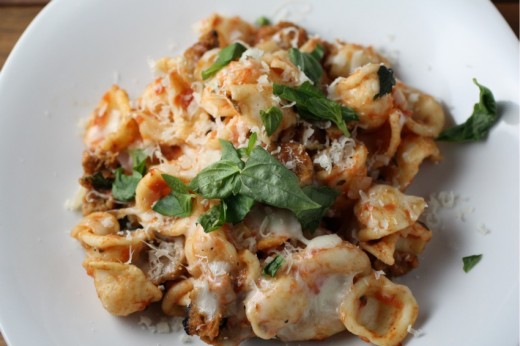
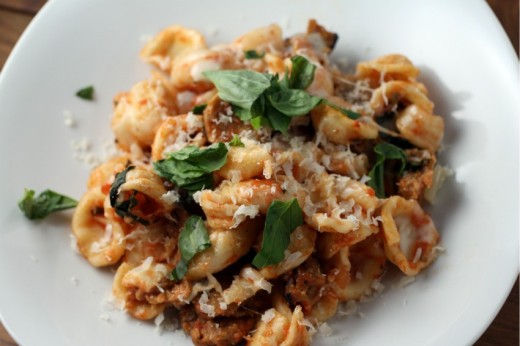
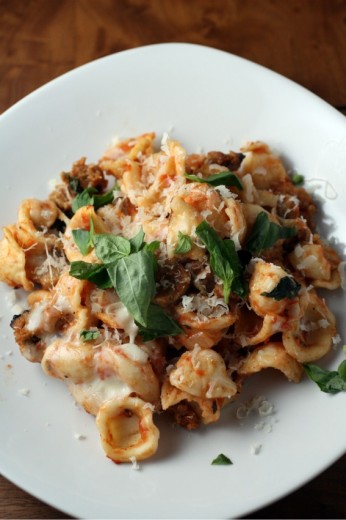
Sometimes Randy and I have weeks where one or both of us is out almost every night.  Last week was like that and I decided to make this hearty and tasty pasta so our boys and whichever parent was home could snack on it throughout the week.  It kept very well, the boys liked, it, and the babysitter thought I was a hero for making dinner in advance.

One Year Ago: (what do you know, another baked pasta!) Pasta with Roasted Cauliflower and Parsley Pesto

Baked Pasta with Tomatoes and Mozzarella
Adapted from Jamie’s Italy
Serves 4-6

My adaptions were to use a different shape pasta and to use much less cheese than he calls for.  If you want it Jamie’s way use “4 big handfuls” of Parmesan cheese and 3 5-oz. balls of mozzarella.  He also says this dish serves 4 but people ate this all week.

Sea salt and freshly ground black pepper
Extra virgin olive oil
1 white onion, peeled and finely chopped
2 cloves of garlic, peeled and finely sliced
1 or 2 dried red chilies, crumbled
3 14-oz. cans of good-quality plum tomatoes
Large handful of fresh basil leaves, plus additional for garnish
Optional:  1 tbsp. red wine vinegar
1 lb. orecchiette (DT: I used radiatore)
1 – 2 cups freshly grated Parmesan cheese
1 8-oz. container fresh mozzarella, thinly sliced

Preheat your oven to 400°F and put a large pot of salted water on to boil.  Heat a couple of glugs of olive oil in an appropriately sized pan.  Add your onion, garlic, and chili and slowly fry for about 10 minutes on a medium to low heat until softened but without any color.  Add the canned tomatoes with a small glass of water.  Bring to a boil and simmer for around 20 minutes.  Now put them through a food processor or blender to make a loose sauce.  Tear your basil leaves into the sauce and correct the seasoning with salt, pepper, and a little red wine vinegar.

When the sauce tastes perfect, bring the water back to a boil.  Add the pasta to the water and cook until it is just shy of al dente (it will continue to cook in the oven).  Drain and toss with half of the tomato sauce and a handful of Parmesan.  Get yourself an appropriately sized baking pan or earthenware dish and rub it with a little olive oil.  Layer a little pasta in the pan, followed by some tomato sauce, a sprinkle of Parmesan, and some mozzarella slices, then repeat these layers until you have used up all the ingredients, ending with a good layer of cheese on top.  Pop the dish into the preheated oven for 15 minutes or until golden, crisp, and bubbling.  Garnish with additional basil leaves, if desired.


One of My Favorites

February 18, 2010

IMG_4586

Have you read the book Cooking for Mr. Latte?  It is by Amanda Hesser who used to be a food critic for the New York Times.  She has also written a cookbook and is working on an intriguing project called Food 52.  Cooking for Mr. Latte is the story of how she met her now husband (the author Tad Friend) and recipes for the food she cooked along the way.  Sound like a familiar premise?  I know, these food-memoirs-with-recipes seem to be everywhere these days.  I just talked about another one in my last post.  But Hesser’s book is from 2003 – before blogs made a big splash and everyone got a book deal.  It’s my favorite of the food memoirs I have read.

Because she was a food critic, her descriptions of food are expert.  You want to be sitting along side her eating.  And her recipes are terrific.  So much so that I keep this little book on my heavy rotation cookbook shelf.  I love the things I have made from this book.  And this is my favorite of the bunch.

Hesser is the first person who told me about Meyer lemons.  The way she talked about them made me go on a mission to seek them out.  These days they are easy to find in Seattle, but just a few years ago it took a lot more investigative work.  They have become one of those “shoulds” in the cooking world.  You know, you “should” eat seasonally, you “should” always use fresh herbs, you “should” make your own salad dressing, and you “should” always use Meyer lemons if you can find them.  Well, I agree with the first three in that list.  And now that I have used Meyer lemons many many times, I have to say that I’m not sure I agree with that last one.  I love lemons.  Meyer lemons are more orange-y tasting and I don’t love oranges.  So, I’m going against the grain and saying no, in general you “should” use whatever lemons you like.

Except in this recipe.  For me, the Meyer lemons work amazingly well here and regular lemons are too mild.  This is a very simple recipe.  Simple in that “simple is sometimes better” way.  I love making this for dinner when recent meals have been complicated or overly spiced or really rich.  It is such a clean dish but not too spare.  Not to be a food snob, but fresh pasta is practically a must here.  You will taste the pasta and you want that pasta to taste good.  (One of these days, I will make my own and when I do, I’m making this one to go with this dish.)

I should have garnished this dish differently for the photo.  I know it looks like white on white.  But trust me.  It is so delicious in that wonderful simple way.  And it takes next to no time to make.  I can’t wait for spring so I can add some blanched asparagus to this bowl.

IMG_4591

One Year Ago:  Tome Yum Soup with Tofu and Mushrooms

Paparadelle with Lemon, Herbs, and Ricotta Salata
Adapted from Cooking for Mr. Latte
Serves 4

I’ve used all different combinations of herbs in this dish – use what you have.  I would keep the amount roughly the same and definitely use the mint.

2 cups vegetable broth
1 clove garlic, peeled and lightly smashed with a  knife
Grated zest of 1 lemon (use a Meyer if possible)
Juice of 1 lemon (ditto)
Sea salt
1 pound paparadelle, broken (or cut) into 2-inch pieces
3 tbsp. chopped mint
2 tbsp. chopped marjoram
1 tbsp. chopped fennel fronds, or tarragon, or chervil
Olive oil
6 ounces ricotta salata, crumbled or shaved
Coarsely ground black pepper

1.  Fill a large pot with water and add enough salt so that you can taste it.  Bring to a boil.  Pour the vegetable broth into a small saucepan, drop in the garlic and bring to a boil.  Reduce by half.  Remove the garlic and shut off the heat.  Stir in the lemon zest and juice.  Season and taste.  It should be full flavored because this will be the sauce for the pasta.  Keep warm.

2.  When the water comes to a boil, add the pasta and cook until soft on the edges but still firm under the tooth.  After a few minutes, ladle out about 1 cup of the cooking liquid and reserve.  Drain the pasta, shake it lightly, then return it to the pot.  Put it over low heat and pour in the broth.  Sprinkle in the mint and other herbs and a little olive oil.  Add some of the reserved cooking liquid and more lemon juice if needed.  Season to taste with salt (keeping in mind that the cheese will add some salt).

3.  Spoon into bowls so that the pasta is lying in a bit of broth.  Scatter the ricotta salata over it, drizzle with a bit more olive oil (DT: I skipped the oil), and grind pepper over the top.


Lasagne with Eggplant and Chard

January 18, 2010

IMG_4502

How do you feel about lasagne?  (And do you spell it lasagna?)  I ask because my husband said something surprising the other night when I told him I was making it for a dinner party.  First he made a face and then he said, “It’s kind of like making spaghetti.”  Coming from him, that is basically an insult.  For reasons that aren’t totally clear to me, Randy hates spaghetti.  Give him some kind of delicious sauce on spaghetti and he won’t like it.  Give him the same sauce on fettucine and he will love it.  I don’t understand but I accept and don’t make spaghetti.

When pressed, he explained that he is used to me making really interesting and unusual things for dinner parties and that lasagne seemed boring and maybe even easy.  I’m sure there are easy ways to make lasagne but for me, it has always been a fairly long and involved process.  Making sauce, making various fillings, roasting vegetables.  Lasagne is not a throw together meal in my world.

What’s more, we were having some friends over for dinner who I don’t know all that well.  Actually, I know the wives well, but I have only met the husbands a handful of times.  I didn’t want to make something really out there (aggressively vegetarian, as I like to call it) and have people not eat it.  I also wanted to make something satisfying so that, if they are used to eating a lot of meat, they didn’t feel like they needed to stop for a hamburger on the way home.  Everyone likes lasagne, right?

IMG_4512

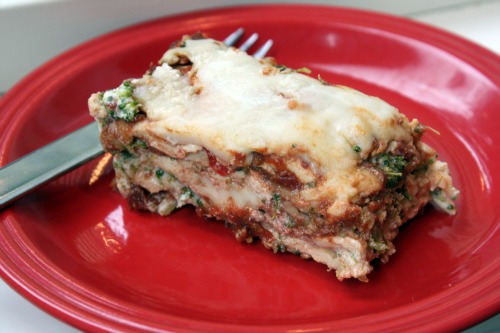
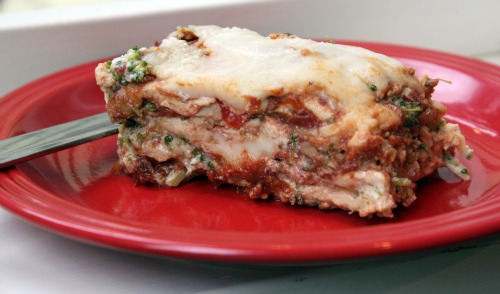
In my many cookbooks, I found a number of recipes that looked inticing.  But I decided against a béchamel sauce and that ruled out many of them.  I wanted something filling but I didn’t want a gut bomb and besides, Randy doesn’t do well with cream sauces.  I settled on this one from Deborah Madison’s Vegetarian Cooking for Everyone and I was very happy with how it turned out.  Hearty and flavorful but not too heavy or cheesy.  Eggplant and I are not the best of friends and I thought Madison’s idea to bake it and then chop it was genius.  Trying to saw through an eggplant round in a lasagne is difficult – pieces of eggplant are easy.  Finally, the greens in the ricotta filling are very welcome.  She calls for chard, I used red kale because I had some.  Their texture is welcome, the color makes it more interesting, and the “green” taste keeps it from being too rich.

Here is a silly little story.  I used to make a very good (but very time consuming) lasagne that featured two different vegetable fillings.  Whenever I made it, I would stress about the sauce.  The amount that the recipe yielded was on the skimpy side and I would fret about it all coming out right.  Not once did it occur to me to increase the amount of sauce I made.  I just stuck to the rules and stressed.  Now that I am older and wiser, I do things my way with lasagne.  I like mine saucy so I make extra sauce.  If the worst thing in the world is having too much homemade tomato sauce, then that is a pretty good world.  You can use it another night on another kind of pasta (not spaghetti!) or you can freeze it with beautiful results.  I give my recipe below, you will use ½ – ¾ of it for the recipe.  And if you would like to just use jarred sauce, I won’t tell anyone.

IMG_4505

One Year Ago: Pea Salad with Radishes and Feta Cheese

Lasagne with Eggplant and Chard
Adapted from Vegetarian Cooking for Everyone
Serves 6-8

1½ pounds fresh pasta sheets, or 1 box dried
Tomato sauce (about 2 cups, recipe follows)
1½ pounds eggplant, sliced crosswise ¼-inch thick
Olive oil
½ onion, finely diced
3 garlic cloves, minced
1 bunch green chard, leaves removed from the stems
Salt and freshly ground black pepper
1/2 dry white wine
1 cup ricotta cheese
1 egg
1 cup grated Pecorino Romano
8 ounces fresh mozzarella, thinly sliced

Prepare the sauce.  If you are using dried pasta, parboil it for a few minutes then drain it and lay out on a sheet pan so it doesn’t stick together.

Preheat the oven to 400°F.  Brush both sides of the eggplant lightly with oil.  Place the slices on a sheet pan and bake, turning once, until browned on both sides, about 30 minutes in all.  Chop coarsely and set aside.  (DT: This step can be done one day ahead.  Cool completely, then cover and refrigerate.)

Heat a large skillet over medium heat.  Add just enough olive oil to coat the bottom, then add the onion and garlic.  Stir frequently for 3 minutes.  Add the chard, sprinkle with a pinch of salt and a few grinds of pepper, and cook until wilted, about 5 minutes.  Add the wine, cover and cook until the chard is tender and the pan is dry, about 10 minutes.  Turn the mixture out onto a cutting board and finely chop.  In a bowl, mix together the ricotta and the egg, then stir in the chard mixture.  Season with salt and pepper.  (DT: This step can be done one day ahead.  Cover and refrigerate.)

Oil a 9- x 13-inch baking dish.  Coat the bottom lightly with sauce and then cover with a layer of pasta.  Scatter a quarter of the Pecorino over the top and add a quarter of the eggplant, ricotta mixture, and mozzarella.  Follow with another layer of pasta and repeat for three more layers.  End with a layer of pasta and top with sauce.  (Sprinkle with more Pecorino if you like.)  Cover with foil.  (DT: The whole lasagne can be made one day ahead.  Keep covered and refrigerate.  It will need another 10 minutes or so of baking time.)

Preheat the oven to 400°F.  Bake 20 to 30 minutes or until heated through.  Remove the foil and bake for another 5 to 10 minutes.  Let stand for 10 minutes before serving.

Dana’s Tomato Sauce
Makes a lot

Of course you can halve this recipe.

1 onion, finely diced
2 garlic cloves, minced
2 tsp. dried basil
1 tsp. dried oregano
1/2 cup good red wine
2- 28 ounce cans whole tomatoes
Salt and freshly ground pepper
Pinch of sugar (optional)

Heat a Dutch oven over medium heat.  Add just enough olive oil to coat the bottom, then add the onion along with a pinch of salt, and sauté until softened, stirring frequently, about 5 minutes.  Add the garlic, stir for another 2 minutes, then add the herbs.  Stir well to combine, then pour in the wine.

Cook, uncovered, until the wine is almost evaporated, then carefully add the two cans of tomatoes.  Bring to a boil, then reduce the heat to a simmer.  Cook until the sauce has thickened, periodically crushing the tomatoes against the side of the pot with a spoon, about 30 minutes.  Taste, adding salt and pepper as necessary and a pinch of sugar if the taste is metallic.  (In my experience, the better the tomatoes, the less of a need for sugar.)  If you prefer a smoother sauce, you can purée it with an immersion blender, or in a stand blender or food processor.  Let the sauce cool before you use a stand machine.


Pasta from the 90’s

January 5, 2010

IMG_4389

Along with just about everyone else in the food blogging world, I was sad to hear about the demise of Gourmet.  I had been getting the magazine for 16 years when it went away.  Truth be told, I actually always preferred the recipes in Bon Appétit and Food and Wine, but I still looked forward to receiving my issue each month.  In my four notebooks where I have years of cut-out recipes, there are countless ones with the Gourmet font.  Including this one.

IMG_4394

This recipe is on the second page of my “pasta” section which means I cut it out way back in 1993 or so.  Grunge.  Living in a crappy one-bedroom apartment in a crappy building in a great neighborhood.  Just learning to cook for myself.  Working as a singing-dancing waitress on a dinner cruise ship.  Oh yes, I did.  Yes I did.  I did “The Electric Slide” with strangers and got paid for it.

These many years later, I still make this dish and it is one of Randy’s favorites.  If you are a vegetarian, you probably often get the “Do you eat a lot of pasta?” question.  (Or my other favorite, “Do you eat a lot of salad?”)  The truth is that I don’t eat a lot of pasta.  It is often my only choice in a restaurant so I eat it out, but I don’t make a lot of it at home.  Not for any good reason, I love pasta, I just find there are a lot of other interesting things to eat in the vegetarian world.

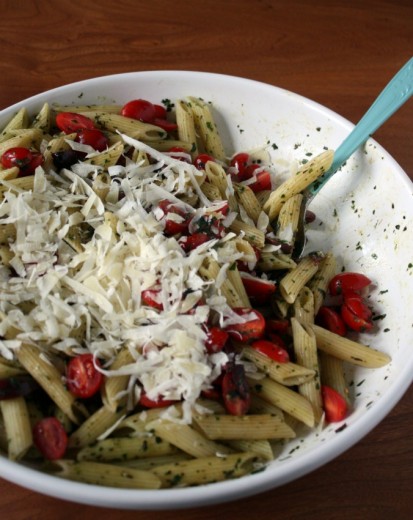
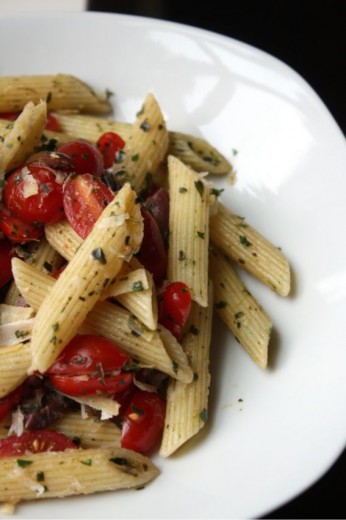
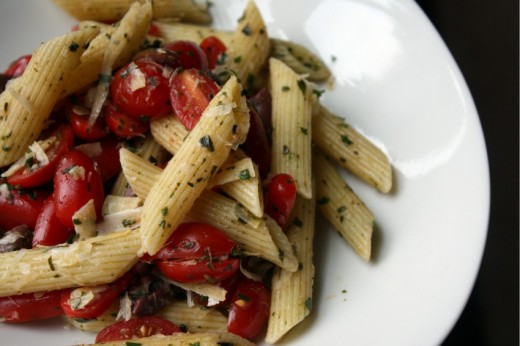
Here are some really good things I can say about this one.  It’s fast.  The sauce is done in the time it takes to cook the noodles.  It is dead easy – no sautéing – just putting all the ingredients together in a pot and cooking them down a bit.  It is made with pantry staples, you always have Kalamata olives, tomato paste, and garlic on hand, right?  And it’s really tasty.  Kind of like a poor man’s puttanesca (and a vegetarian one at that.)  Lastly, this is a very low-fat and low-calorie dish.  The only fat comes from the olives and that is good fat, the heart-healthy kind.  OK, yes, there is a sprinkle of Parmesan cheese on top, but that is optional and besides, it’s just a sprinkle.  I have changed the recipe quite a bit in the years I have been making it.  It was originally called Bruce’s Pasta Sauce but I’m changing it to Bruce and Dana’s Pasta Sauce.

IMG_4395

One Year Ago:  Curried Red Lentil Stew with Vegetables

Bruce and Dana’s Pasta Sauce
Loosely adapted from Gourmet
3-4 servings

This is the kind of sauce that really hugs the noodles so it is best with something short and ridgey, like radiattore.  In this dish, I like it pretty dry, so I usually make one pound of pasta with this much sauce.  This last time, I made 3/4 of a pound and you can see it is a little saucier.  Do what you like best.  Also, if you don’t sprinkle with Parmesan, this dish is vegan.

1/2 cup dry sherry
1/2 cup water
1 6-oz. can tomato paste
1 cup Kalamata olives, pitted and coarsely chopped
3 garlic cloves, minced or pressed
1/2 tsp. crushed red pepper flakes (less if you don’t like heat)
1 tsp. dried oregano
1 tsp. dried thyme
1 tsp. sugar
2 tbsp. dry red wine
1 tsp. balsamic vinegar

Put all ingredients in a saucepan and bring to a simmer.  Cook, uncovered, until thickened, about 20 minutes.  Boil pasta (3/4 to 1 pound) until al dente.  Scoop the pasta directly into the sauce pan and stir well to combine.  Serve with a sprinkle of Parmesan cheese.


Lunch for Kelly

December 31, 2009

IMG_4327

A couple of months ago, I got a call from a guy speaking in a hushed voice.  He said he had locked himself in the bathroom and wanted to arrange something with me.  His name was Gregg and he is the husband of one of my close friends.

Now, you may be thinking something naughty but what Gregg wanted to arrange with me was a surprise lunch for his lovely bride.  Kelly’s birthday is December 31st – a New Year’s Eve baby – and this year she turns 40.  He wanted to do something special for her and first he asked me if I was free to come to the lunch.  Once I said yes, he sheepishly asked me if I would cater it.  I laughed out loud and said of course.

I have known Kelly since 3rd grade but we really became friends our freshman year in high school.  We have taken road trips together, thrown parties, done lots of laughing, and even lived together for a year.  She has two boys as well and we have enjoyed getting our kids together, although not as often as either of us would like.  Kelly is a quality person, a class act as my dad likes to say.  She deserved to find happiness with a wonderful man and that she did.  Not only did Gregg invite 15 people to their house for lunch, but he is sending her out for some spa treatment so that I can set everything up without being detected.  Can we all stand up and give Gregg a hand?

So, what’s for lunch?  Well, the birthday cake will be this one.  I am making two galettes – the Butternut Squash one and the Roasted Tomato one.  I’m making a Mediterranean chick pea salad.  I plan to have veggies and Buttermilk dip on hand for people to snack on.  And I made this pasta salad.

IMG_4329

One of my least favorite words for food is gloppy.  In my book, anything with mayonnaise is gloppy and for some reason most pasta salad, even if it doesn’t star mayo, is gloppy.  Over-dressed, over-cooked pasta, under-seasoned.  If you agree with me, you might want to try this recipe.  It is far from gloppy.  In fact, it is light and bright and very tasty.  Golden beets, almonds, fennel, and radicchio mix together with Orecchiette in a lemony dressing.  It’s one of those wonderful recipes that looks and tastes great.  Happy birthday, Kell!

My little family and I are going to be heading out of town right after lunch for 2 nights away with wonderful friends.  If I could, I would personally wish each and every one of you amazing people who read this blog a Happy New Year, but my super powers only extend so far.  I hope your 2009 was filled with life, love, and good food and I wish you more of the same in 2010!

IMG_4321

One Year Ago:  Vegetable Couscous Paella and Manchego Skewers

Orecchiette Salad with Roasted Beets, Fennel, & Toasted Almonds
Adapted from Macrina Bakery and Café Cookbook
Serves 4-6

Do yourself a favor and serve this (and every) pasta salad at room temperature.  It needs some warmth for the flavors to bloom.  Also, don’t be afraid of salt here.  Add enough to make the flavors pop.

2 medium golden beets, washed
4 tbsp. olive oil
Kosher salt
Freshly ground black pepper
¾ cup whole almonds
2 cups dry orecchiette pasta
1 cup thinly sliced radicchio
½ cup thinly sliced fennel bulb
¼ cup chopped fennel fronds
½ cup sliced scallions
¼ cup chopped fresh Italian parsley
1/3 cup Lemon Vinaigrette (recipe follows)

Preheat oven to 350°F.

Place washed beets in the center of a large piece of aluminum foil.  Drizzle with 2 tablespoons of the olive oil and season with a bit of salt and pepper.  Gather up the edges of the foil and seal the beets inside a pouch.  Bake on center rack of oven for about 1 hour, or until beets are tender when poked with a fork.  Let cool, then peel the beets and chop to a medium dice.  Set aside.  Leave oven on.

Spread almonds on a rimmed baking sheet and toast for 15 minutes, or until golden brown.  (This can be done while the beets are roasting.)  Let almonds cool, then coarsely chop and set aside.

Fill a large saucepan with water.  Add a pinch of kosher salt and bring to a boil.  Drop in pasta and simmer for 10-12 minutes, or until tender.  Drain in a colander, shaking off excess water.  Toss with 2 tablespoons of olive oil to keep pasta from sticking.

Add the diced beets, toasted almonds, radicchio, fennel bulb and fronds, scallions, and parsley.  Drizzle in Lemon Vinaigrette and toss all ingredients together.  Season to taste with kosher salt and pepper.  Cover and store in the refrigerator for up to 2 days.

Lemon Vinaigrette
Makes approximately 1¼ cups

This dressing makes more than you need for the pasta salad, but it’s also delicious used as a green salad dressing.  Go ahead and make the whole amount and use it over the course of a week.

1 tbsp. Dijon mustard
2 tsp. red wine vinegar
1/3 cup freshly squeezed lemon juice
1 tsp. honey
1 tbsp. freshly grated lemon zest
1 garlic clove, finely chopped or pressed
1 tsp. kosher salt
½ tsp. freshly ground pepper
¾ cup olive oil

Combine mustard, vinegar, lemon juice, honey, lemon zest, garlic, salt and pepper in a medium bowl.  Mix well with a whisk.  Add olive oil in a slow stream, whisking as you pour in the oil.  Continue whisking until dressing has emulsified, then cover and store in the refrigerator.


« Older Posts Newer Posts »